
Procedure guide
Canthoplasty (Lateral Canthoplasty) in Korea
- Surgery time Around 0.5 hour
- Anesthesia type Local anesthesia with sleeping sedation
- Hospitalization Not required
- Face wash & makeup 5 – 7 days after surgery
- Post-surgery check-up 1 time (depending on the patient's condition)
- Stitches removal 5 – 7 days after surgery


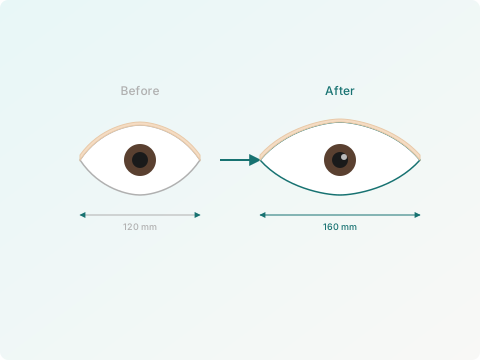
Canthoplasty, specifically lateral canthoplasty, is a procedure that lengthens the outer corner of the eye by releasing and repositioning the lateral canthal tendon. The goal is to create a longer, more open horizontal eye aperture — making the eyes appear wider and the gaze softer without altering the eyelid crease itself.
This procedure is particularly popular in Korea because many East Asian patients have a relatively short palpebral fissure (eye opening width). Korean surgeons have developed refined lateral canthoplasty techniques that extend the outer corner while preserving a natural, tapered eye shape and preventing the pink conjunctival tissue from becoming permanently visible — a complication called scleral show or conjunctival exposure that less experienced techniques can produce.
At a glance | |
Surgery time | 30 – 50 minutes |
|---|---|
Anaesthesia | Local with sedation |
Hospital stay | Outpatient — discharged same day |
Back to routine | 5 – 7 days |
Final result | 2 – 4 months |
This page is for informational purposes. Individual results vary. A board-certified surgeon should evaluate your anatomy before any procedure.
How it works
Lateral canthoplasty extends the horizontal eye opening by repositioning the outer canthal angle. The technique requires precision to prevent regression and visible scarring.
- Planning — The surgeon measures the current palpebral fissure width, assesses the lateral canthal angle, and marks the desired extension length (typically 2 – 4 mm). The direction of the extension (horizontal or slightly upward) is tailored to the patient's facial proportions.
- Anaesthesia — Local anaesthetic is injected around the outer corner of the eye. Sedation keeps the patient comfortable.
- Access & release — A small incision is made at the lateral canthus. The lateral canthal tendon is carefully divided, and the conjunctiva at the outer corner is dissected to create a new, wider opening. The surgeon ensures the mucosal lining (conjunctiva) is properly advanced so that raw tissue is not exposed.
- Reshaping & fixation — The new canthal angle is secured by suturing the conjunctival flap and the skin edge to the periosteum at the lateral orbital rim, stabilising the widened eye shape and preventing retraction.
- Closing — Fine absorbable and non-absorbable sutures close the incision. The scar sits within the natural crease at the outer eye corner and becomes virtually invisible once healed.
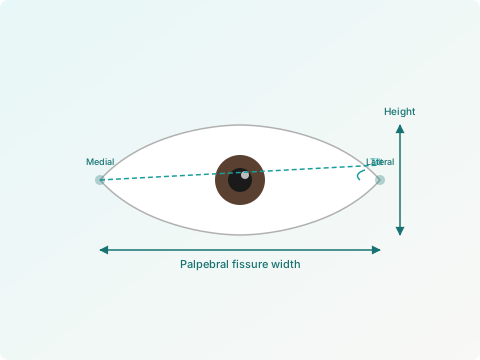
Eye shape analysis
The surgeon evaluates the intercanthal distance, palpebral fissure width, and eye tilt to plan lateral or medial canthoplasty for the desired shape.
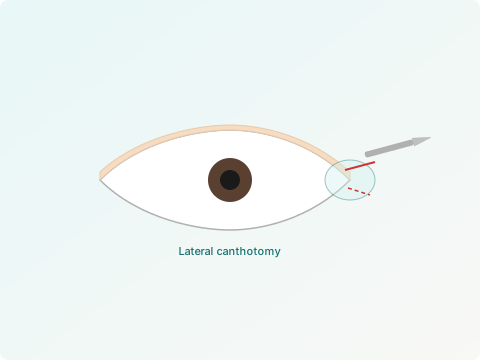
Canthal incision
A small incision is made at the lateral (outer) or medial (inner) corner of the eye, releasing the canthal tendon to allow repositioning.
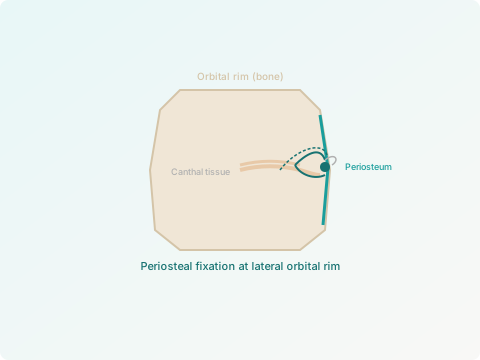
Corner reshaping
The exposed conjunctiva is sutured to the new position, widening the eye horizontally. The canthal angle is adjusted to achieve the planned eye shape.
Closure & healing
Fine sutures close the incision. Antibiotic ointment is applied. The scar at the eye corner fades to near-invisibility within a few months.
Cost · as of 2026
Through Seoul Medical Insider, lateral canthoplasty pricing in Korea is fully transparent. The quote includes the surgeon's fee, anaesthesia, operating room, and follow-up appointments. There are no intermediary markups.
Cost depends on whether the procedure is performed alone or in combination with double eyelid surgery, epicanthoplasty (inner corner), or ptosis correction. Standalone canthoplasty is a shorter procedure and generally less expensive, but most patients achieve the best aesthetic balance by combining it with at least one complementary eye procedure.
All pricing is reviewed and confirmed as of 2026. Submit your photos through our consultation form to receive a personalised quote.
Who it is for
Lateral canthoplasty is designed for patients who want wider-looking eyes with a softer, more open gaze.
- Suited for: Patients with a short horizontal palpebral fissure who feel their eyes appear small or narrow despite having a double eyelid fold.
- Suited for: Patients with an upward-slanting outer eye corner that creates a sharp or fierce expression — lowering the angle softens the overall look.
- Suited for: Patients undergoing double eyelid surgery or ptosis correction who want additional widening to complement the increased vertical opening.
- Discuss carefully: Patients with loose lower eyelids or pre-existing scleral show — extending the outer corner may worsen lower lid laxity and expose more white below the iris.
- Discuss carefully: Patients expecting dramatic lengthening beyond 4 mm — the amount of safe extension is limited by the anatomy of the lateral orbital wall and conjunctival tissue availability.
Recovery
- Week 1: Mild to moderate swelling and possible bruising around the outer eye corners. The new eye shape appears wider than the final result because of tissue oedema. The outer corner may look reddish where the conjunctiva is healing. Sutures are removed around day 5 – 7.
- Weeks 2 – 3: Redness at the outer corner fades gradually. The eye shape starts to look more natural. Avoid rubbing the eyes or sleeping face-down to protect the healing canthal angle.
- Weeks 4 – 8: The outer corner scar matures and blends with surrounding skin. Any pinkness at the new canthal angle continues to fade. The widened eye shape stabilises.
- Months 2 – 4: Final result is visible. The scar at the outer corner is typically imperceptible. The eyes appear naturally wider and the horizontal balance of the face is improved.
A stay of at least 7 days in Korea is recommended. Suture removal and a check on the canthal angle healing are essential before departing. If canthoplasty is combined with other eye procedures, allow 7 – 10 days.
Risks & considerations
Lateral canthoplasty is a relatively small procedure but involves delicate structures. Possible risks include regression of the widened angle as scar tissue contracts during healing (partial loss of the gained length), visible scarring at the outer corner if wound care is insufficient, conjunctival exposure or persistent redness at the new canthal angle, asymmetry between the two sides, webbing of the skin at the outer corner (a small fold caused by tension), lower eyelid retraction or ectropion in patients with pre-existing lid laxity, and very rarely, infection. Skilled Korean surgeons minimise regression by anchoring the new angle to the periosteum and advancing the conjunctival lining to cover the raw surface.
Korea trip checklist
- Send close-up photos of both eyes (looking straight ahead, eyes wide open, and from the side) during your online consultation so the surgeon can assess your lateral canthal anatomy.
- Discontinue blood-thinning medications and supplements at least 7 days before the procedure.
- The outer eye corners will be sensitive — bring wraparound sunglasses to shield against wind and UV exposure after surgery.
- Avoid wearing eye makeup and contact lenses for at least 2 weeks post-op. Pack glasses as your primary eyewear for the trip.
- Book accommodation within easy reach of the clinic for the first week; you will visit for suture removal and a healing check.
- Do not plan your return flight before day 7. The surgeon needs to verify that the canthal angle is healing properly and the sutures are ready for removal.
Clinical details are summarized from materials provided by SMI's partner clinics and published guidance from the Korean Society of Plastic and Reconstructive Surgeons (KSPRS). Technique selection is determined by your surgeon during consultation. SMI is a registered patient-facilitation agency, not a medical provider, and does not offer medical advice.
Why get this procedure in Korea
-
World-leading surgical volume
Korean plastic surgeons perform more facial procedures per capita than any other country, refining techniques through high case volumes.
-
Board-certified specialists
All SMI partner surgeons hold Korean Board of Plastic Surgery certification and operate at JCI or KOIHA-accredited facilities.
-
40-60% cost savings
Comparable or superior results at a fraction of US/EU pricing, with no compromise on safety standards or technology.
You may also consider
Related guides
- Double Eyelid Surgery in Korea: A Complete Cost & Methods Guide A clear, educational guide to double eyelid surgery in Korea — incisional vs non-incisional, what drives cost, recovery, and choosing a surgeon.
- How Long Should You Stay in Korea After Plastic Surgery? A logistics hub for international patients — typical recovery-stay windows by procedure, when you can safely fly home, and the visa and interpreter basics for a trip to Seoul.
- The Real All-In Cost of Plastic Surgery in Korea (Beyond the Quote) The surgery quote is only part of the bill. A clear, honest framework for the all-in cost of plastic surgery in Korea — every line item, plus how to avoid hidden fees and the foreigner price gap.
Frequently asked questions
Sources
- Ministry of Health and Welfare, Republic of Korea
- Medical Korea (KHIDI)
- Korea Health Industry Development Institute (KHIDI)
- Korean Society of Plastic and Reconstructive Surgeons (KSPRS)
- International Society of Aesthetic Plastic Surgery (ISAPS)
Read our editorial policy to learn how we source and verify information.
