
Procedure guide
Nostril Reduction (Alarplasty) in Korea
- Surgery time Around 0.5 hour
- Anesthesia type Local anesthesia
- Hospitalization Not required
- Face wash & makeup 5 days after surgery
- Post-surgery check-up 1 time (depending on the patient's condition)
- Stitches removal 5 – 7 days after surgery



Nostril reduction, also known as alarplasty or alar base reduction, is a rhinoplasty procedure that narrows wide or flared nostrils to bring them into better proportion with the rest of the nose and the face. It addresses the width of the alar base (the fleshy outer walls of the nostrils), nostril flare on animation (smiling or breathing deeply), and the overall width of the nasal base as seen from the front.
Korean plastic surgeons frequently perform alarplasty because nostril width management is a critical component of achieving a balanced rhinoplasty result — particularly for patients who have had tip plasty or bridge augmentation and need the base width refined to match. Korean techniques emphasise minimal scarring by placing incisions in the natural crease where the nostril meets the cheek (alar-facial groove) and using precise wedge excisions to achieve millimetre-level adjustments.
At a glance | |
Surgery time | 20 – 40 minutes |
|---|---|
Anaesthesia | Local anaesthesia (sedation optional) |
Hospital stay | Outpatient — discharged same day |
Back to routine | 5 – 7 days |
Final result | 2 – 3 months |
This page is for informational purposes. Individual results vary. A board-certified surgeon should evaluate your anatomy before any procedure.
How it works
Alarplasty reduces nostril width by excising small wedges of tissue from the alar base, the nostril sill, or both. The technique is chosen based on whether the width comes from flared alar walls, a wide nostril floor, or both.
- Planning — The surgeon measures the alar base width relative to the intercanthal distance (the space between the inner corners of the eyes — the classic aesthetic guideline is that the base width should roughly equal this distance). The type and location of excision are marked: alar wedge (at the alar-facial junction), nostril sill (on the floor of the nostril), or a combination.
- Anaesthesia — Local anaesthetic is injected around the alar base. The procedure is quick enough that many patients do not require sedation, though it is available for comfort.
- Excision — For alar base reduction, a small wedge of skin and soft tissue is removed from the junction where the nostril wall meets the cheek. For nostril sill reduction, a wedge is excised from the nasal floor between the columella and the alar base. The amount removed is typically 1 – 4 mm per side, carefully measured to ensure symmetry.
- Shaping — The wound edges are aligned precisely. In some cases the surgeon uses a cinching suture through the nasal sill to bring the alar bases closer to the columella without any external excision (Weir technique).
- Closing — Fine 6-0 or 7-0 sutures close the incision. Meticulous alignment of the skin edges is critical for minimising scarring. Sutures are removed at day 5 – 7.
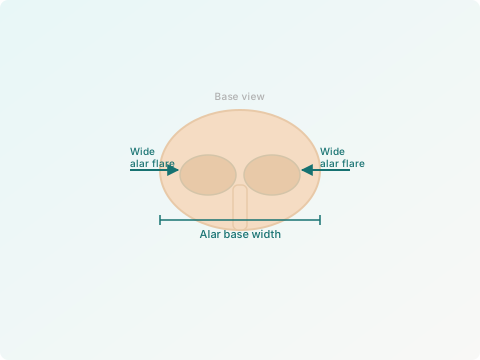
Nostril measurement
The surgeon measures nostril width, flare, and base dimensions relative to the nasal tip and intercanthal distance to plan the optimal reduction.
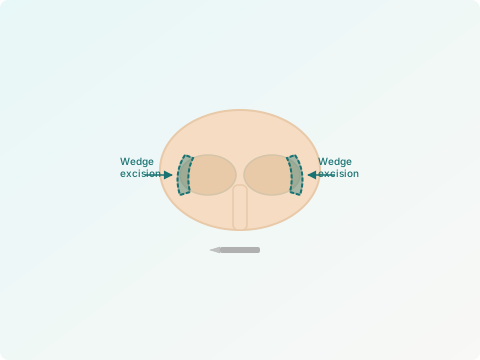
Alar wedge excision
A small wedge of tissue is excised from the nostril base or alar sidewall. The exact placement depends on whether width or flare needs correction.
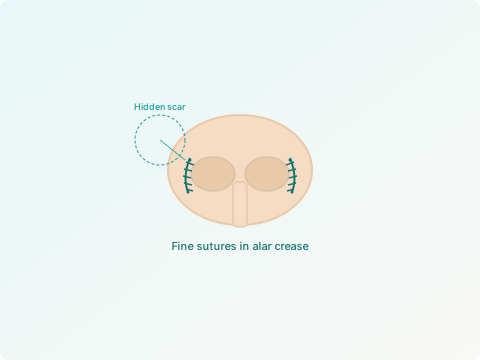
Precise suturing
The excision site is closed with very fine sutures that sit within the natural alar crease. Careful tension distribution prevents asymmetric healing.
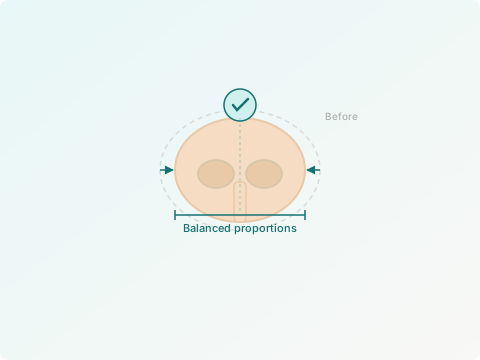
Scar management
The small scars at the nostril base are virtually invisible once healed. Silicone scar sheets and sun protection accelerate the fading process.
Cost · as of 2026
Through Seoul Medical Insider, nostril reduction in Korea is priced with full transparency. The quoted fee includes the surgeon's fee, local anaesthesia, the procedure room, and all follow-up visits. No agency markups are applied.
Alarplasty is one of the more affordable rhinoplasty procedures when performed alone due to its shorter operative time and use of local anaesthesia. Cost increases if it is combined with tip plasty, bridge rhinoplasty, or revision work. The technique chosen (external wedge excision vs. internal sill reduction vs. cinching suture) can also influence the price.
All pricing is reviewed and confirmed as of 2026. Submit front and base-view photos of your nose through our consultation form for a personalised quote.
Who it is for
Alarplasty is a focused, relatively quick procedure ideal for patients whose primary concern is nostril width or flaring.
- Suited for: Patients with wide, flared nostrils that are disproportionate to the overall nasal width and the face.
- Suited for: Patients who have had tip plasty or rhinoplasty but still have nostrils that appear wide relative to the refined bridge and tip.
- Suited for: Patients with excessive nostril show (the nostrils are prominently visible from the front view) due to alar flaring rather than a short columella.
- Discuss carefully: Patients with thick alar skin prone to hypertrophic or keloid scarring — the incision at the alar-facial groove may produce a noticeable scar. A test spot or scar history should be evaluated.
- Discuss carefully: Patients who want narrowing beyond 3 – 4 mm per side — over-resection can make the nostrils look unnaturally pinched and compromise nasal breathing.
Recovery
- Week 1: Mild swelling around the alar base and lower nose. Small adhesive strips or sutures are visible at the nostril-cheek junction. Discomfort is minimal — most patients describe it as tightness rather than pain. Sutures are removed at day 5 – 7. Avoid smiling widely or stretching the nose, which pulls on the incision.
- Weeks 2 – 3: Suture marks and redness at the incision sites fade. The narrowed nostril shape is visible, though mild swelling may make the nostrils look slightly fuller than the final result. Normal facial expressions resume comfortably.
- Weeks 4 – 8: The scars at the alar-facial junction mature and lighten. The final nostril width is essentially achieved. Any residual firmness softens.
- Months 2 – 3: Scars are typically very faint, blending into the natural crease between the nostril and the cheek. The base width and nostril shape are stable.
A minimum 7-day stay in Korea is recommended. Suture removal on day 5 – 7 is important because leaving sutures in too long increases scarring risk in this visible area. If alarplasty is combined with other nose procedures, follow the longer recovery timeline of the primary procedure.
Risks & considerations
Alarplasty is a small-scale procedure but involves incisions in a highly visible area. Possible risks include visible or widened scarring at the alar-facial groove (the most commonly discussed concern — meticulous suturing technique and scar care minimise this), asymmetric nostril width or shape, over-resection creating an unnaturally narrow or pinched nasal base, under-resection leaving the patient wanting further narrowing, notching of the nostril rim if the excision encroaches on the alar margin, compromised nasal breathing if the internal nasal valve is narrowed excessively, and rarely, wound dehiscence (incision opening) if the area is stressed before healing is complete. Patients with darker skin tones should discuss scar management proactively, as hyperpigmentation at the incision site is possible.
Korea trip checklist
- Send clear front-view and base-view (looking upward) photos of your nose during the online consultation — nostril width and flare are best assessed from these angles.
- Inform the surgeon of any history of keloid or hypertrophic scarring — this affects the surgical plan and post-operative scar management protocol.
- Stop blood-thinning medications and supplements at least 7 days before the procedure.
- Alarplasty is often performed under local anaesthesia with no sedation, so you can eat a light meal beforehand. Confirm fasting instructions with your clinic if sedation is planned.
- Bring a gentle, fragrance-free wound care ointment (such as petroleum jelly or prescribed scar cream) — you will apply it to the incision sites several times daily.
- Avoid direct sun exposure on the nose for at least 4 weeks post-op. UV light can darken healing scars. Bring SPF 50+ sunscreen and a hat.
- Book accommodation near the clinic and schedule your return flight no earlier than day 7 to allow suture removal and a scar check.
Clinical details are summarized from materials provided by SMI's partner clinics and published guidance from the Korean Society of Plastic and Reconstructive Surgeons (KSPRS). Technique selection is determined by your surgeon during consultation. SMI is a registered patient-facilitation agency, not a medical provider, and does not offer medical advice.
Why get this procedure in Korea
-
World-leading surgical volume
Korean plastic surgeons perform more facial procedures per capita than any other country, refining techniques through high case volumes.
-
Board-certified specialists
All SMI partner surgeons hold Korean Board of Plastic Surgery certification and operate at JCI or KOIHA-accredited facilities.
-
40-60% cost savings
Comparable or superior results at a fraction of US/EU pricing, with no compromise on safety standards or technology.
You may also consider
Related guides
- Rhinoplasty in Korea: The International Patient’s Cost & Surgery Guide A clear, educational guide to rhinoplasty in Korea for foreigners — procedure types, what drives cost, recovery, and how to choose a surgeon safely.
- Rhinoplasty Recovery in Korea: A Week-by-Week Aftercare Guide for International Patients Planning rhinoplasty in Korea? This guide walks you through the full recovery timeline—from the first 48 hours to final results—with practical aftercare tips tailored to international patients.
- How Long Should You Stay in Korea After Plastic Surgery? A logistics hub for international patients — typical recovery-stay windows by procedure, when you can safely fly home, and the visa and interpreter basics for a trip to Seoul.
- Is Plastic Surgery in Korea Safe? A Patient's Guide to Avoiding Ghost Surgery A balanced look at safety in Korea's plastic surgery industry — what ghost surgery is, the laws that protect you, and the checks every international patient should make before booking.
Frequently asked questions
Sources
- Ministry of Health and Welfare, Republic of Korea
- Medical Korea (KHIDI)
- Korea Health Industry Development Institute (KHIDI)
- Korean Society of Plastic and Reconstructive Surgeons (KSPRS)
- International Society of Aesthetic Plastic Surgery (ISAPS)
Read our editorial policy to learn how we source and verify information.
