
Procedure guide
Eye Bag Fat Reposition in Korea
- Surgery time Around 0.5 – 1 hour
- Anesthesia type Local anesthesia with sleeping sedation
- Hospitalization Not required
- Face wash & makeup 7 days after surgery
- Post-surgery check-up 1 time (depending on the patient's condition)
- Stitches removal 7 days after surgery



Eye bag fat repositioning is a lower eyelid procedure that corrects under-eye bags by moving — rather than simply removing — the herniated orbital fat that causes bulging beneath the eyes. The displaced fat is shifted downward into the tear trough depression, simultaneously eliminating the bag and filling the hollow groove. The result is a smooth, rested under-eye contour without the sunken appearance that pure fat removal can create.
Korean oculoplastic and plastic surgeons favour the transconjunctival approach (incision inside the lower eyelid), which leaves no visible external scar. Korea's high surgical volume in lower blepharoplasty and fat repositioning means surgeons have extensive experience managing the delicate balance between enough fat transfer to fill the hollow and enough reduction to flatten the bag.
At a glance | |
Surgery time | 50 – 80 minutes |
|---|---|
Anaesthesia | Local with sedation or light general |
Hospital stay | Outpatient — discharged same day |
Back to routine | 7 – 10 days |
Final result | 2 – 4 months |
This page is for informational purposes. Individual results vary. A board-certified surgeon should evaluate your anatomy before any procedure.
How it works
Fat repositioning addresses the root cause of eye bags — weakened orbital septum allowing fat to herniate forward — by using the patient's own displaced fat to correct the adjacent hollow.
- Planning — The surgeon evaluates the three orbital fat compartments (medial, central, lateral), the depth of the tear trough, and the skin quality of the lower lid. Photography under direct lighting maps the contour irregularities.
- Anaesthesia — Local anaesthetic is infiltrated into the lower lid and orbital floor. IV sedation or light general anaesthesia is used depending on patient preference and the surgeon's protocol.
- Access (transconjunctival) — An incision is made on the inner surface of the lower eyelid (conjunctiva), behind the lash line. This avoids any visible external scar.
- Fat mobilisation & reposition — The herniated fat pads are carefully freed from the orbital septum, rotated inferiorly over the orbital rim, and laid into the tear trough groove. The fat pedicle is sutured to the periosteum of the maxilla, holding it in its new position. If excess fat remains after filling the trough, a conservative amount may be removed.
- Closing — The conjunctival incision is closed with absorbable sutures or allowed to heal without stitches, depending on the surgeon's technique. No external suture removal is required.
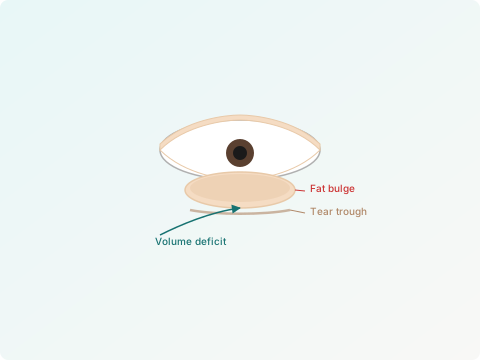
Under-eye assessment
The surgeon evaluates the degree of fat herniation, tear trough depth, and skin quality to choose between transconjunctival or subciliary approach.
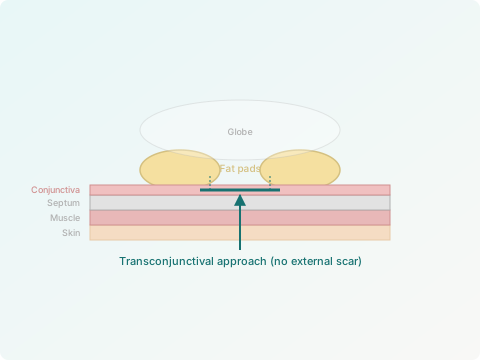
Fat pad access
Through an incision inside the lower eyelid (transconjunctival) or just below the lash line, the herniated orbital fat pads are carefully exposed.
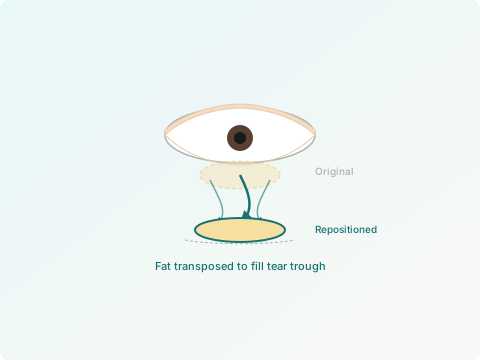
Fat repositioning
Instead of removing the fat, the surgeon redistributes it over the orbital rim into the tear trough depression, filling the hollow and smoothing the contour.
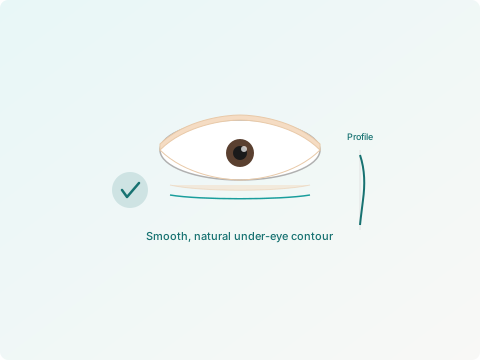
Closure & recovery
Transconjunctival incisions require no external sutures. Subciliary incisions are closed with fine stitches hidden along the lash line.
Cost · as of 2026
Through Seoul Medical Insider, lower eyelid fat repositioning in Korea is quoted with full transparency. The price covers the surgeon's fee, anaesthesia, the operating facility, and all standard post-operative follow-ups. No agency markups are added.
Pricing depends on the complexity of the fat repositioning — whether one, two, or all three fat compartments require mobilisation, whether a pinch excision of excess lower lid skin is added, and whether the procedure is a primary surgery or a revision correcting a previous lower blepharoplasty. Patients who also need fat grafting to the mid-face for additional volume will see a combined price.
All pricing is reviewed and confirmed as of 2026. Submit under-eye photos (front and 45-degree angle, in natural light) through our consultation form for a personalised quote.
Who it is for
Fat repositioning is the current standard of care for under-eye bags because it corrects both the bulge and the hollow in a single step.
- Suited for: Patients with prominent under-eye bags caused by herniated orbital fat, especially when accompanied by a visible tear trough depression.
- Suited for: Younger patients (late 20s – 40s) with good lower lid skin elasticity who primarily have a fat-related contour issue rather than loose skin.
- Suited for: Patients who look tired despite adequate sleep due to shadowing created by the bag-to-trough transition.
- Discuss carefully: Patients with significant lower lid skin laxity or festoons — an external (subciliary) approach with skin tightening may be needed in addition to or instead of a purely transconjunctival method.
- Discuss carefully: Patients with very deep midface hollowing — fat repositioning alone may not provide enough volume, and supplemental fat grafting or filler may be recommended.
Recovery
- Week 1: Under-eye swelling and bruising are most prominent in the first 3 – 4 days. The lower lids may feel tight and the tear trough area looks puffy. Sleep with two pillows to elevate the head. Avoid bending forward. Cool compresses help reduce swelling. Because the incision is inside the eyelid, there are no external sutures to remove.
- Weeks 2 – 3: Bruising resolves for most patients. Swelling diminishes noticeably but the under-eye area may still feel firm. Light social and work activities can resume. Avoid strenuous exercise and heavy lifting.
- Weeks 4 – 8: The repositioned fat settles into its final position. The tear trough fills in smoothly. Minor firmness or numbness fades gradually.
- Months 2 – 4: Final contour is achieved. The under-eye area appears smooth and rested with no visible scar.
Plan to stay in Korea for at least 7 days. Although there are no external sutures, the surgeon will want to assess the healing of the transconjunctival incision and check the repositioned fat contour at around day 5 – 7. If combined with upper eyelid surgery, a 10-day stay is advisable.
Risks & considerations
Lower eyelid fat repositioning is a well-established procedure, but risks exist. Possible complications include prolonged swelling or bruising (especially if the patient resumes activity too early), chemosis (swelling of the conjunctival membrane causing a watery, jelly-like appearance on the white of the eye — typically resolves within 1 – 2 weeks), under-correction leaving residual bulging, over-correction causing a hollowed appearance, lower lid retraction or ectropion (downward pulling of the lid margin — rare with the transconjunctival approach), asymmetry between sides, numbness or altered sensation in the lower lid, and very rarely, retrobulbar haematoma (bleeding behind the eye), which is a medical emergency. Experienced surgeons mitigate these risks through meticulous haemostasis and conservative fat handling.
Korea trip checklist
- Take clear under-eye photos in natural light (front and 45-degree angles, without makeup or concealer) and submit them during your online consultation.
- Stop blood-thinning medications and supplements (aspirin, ibuprofen, omega-3, vitamin E, ginkgo biloba) at least 7 – 10 days before surgery.
- Purchase gel-type cold compresses or prepare ice packs at your accommodation before surgery day — you will use them frequently for the first 3 days.
- Bring dark sunglasses for UV protection and to feel comfortable in public while bruising is visible.
- Stock your accommodation with soft, easy-to-eat foods. Avoid very hot or spicy meals for the first few days, as they can increase facial blood flow and worsen swelling.
- Do not schedule your flight home before day 7. The surgeon needs to verify healing and rule out complications such as chemosis or lid malposition.
- If you take blood pressure medication, continue taking it as normal — well-controlled blood pressure reduces the risk of post-operative bleeding.
Clinical details are summarized from materials provided by SMI's partner clinics and published guidance from the Korean Society of Plastic and Reconstructive Surgeons (KSPRS). Technique selection is determined by your surgeon during consultation. SMI is a registered patient-facilitation agency, not a medical provider, and does not offer medical advice.
Why get this procedure in Korea
-
World-leading surgical volume
Korean plastic surgeons perform more facial procedures per capita than any other country, refining techniques through high case volumes.
-
Board-certified specialists
All SMI partner surgeons hold Korean Board of Plastic Surgery certification and operate at JCI or KOIHA-accredited facilities.
-
40-60% cost savings
Comparable or superior results at a fraction of US/EU pricing, with no compromise on safety standards or technology.
You may also consider
Related guides
- Lower Blepharoplasty in Korea: Eye Bag Removal, Fat Repositioning, Costs, and How to Choose a Safe Clinic A practical guide to lower blepharoplasty in Korea for international patients — comparing fat repositioning with fat removal, incision approaches, typical price ranges, the recovery timeline, and how to vet a board-certified clinic.
- Fat Grafting in Korea: What International Patients Should Know About Fat Transfer Procedures Korea has become a leading destination for fat grafting procedures, from facial rejuvenation to breast and body contouring. This guide covers what international patients need to know about techniques, costs, recovery, and choosing a qualified surgeon.
- How Long Should You Stay in Korea After Plastic Surgery? A logistics hub for international patients — typical recovery-stay windows by procedure, when you can safely fly home, and the visa and interpreter basics for a trip to Seoul.
- The Real All-In Cost of Plastic Surgery in Korea (Beyond the Quote) The surgery quote is only part of the bill. A clear, honest framework for the all-in cost of plastic surgery in Korea — every line item, plus how to avoid hidden fees and the foreigner price gap.
Frequently asked questions
Sources
- Ministry of Health and Welfare, Republic of Korea
- Medical Korea (KHIDI)
- Korea Health Industry Development Institute (KHIDI)
- Korean Society of Plastic and Reconstructive Surgeons (KSPRS)
- International Society of Aesthetic Plastic Surgery (ISAPS)
Read our editorial policy to learn how we source and verify information.
