
Procedure guide
Hairline Lowering Surgery in Korea
- Surgery time Around 1 – 2 hours
- Anesthesia type Local anesthesia with sleeping sedation
- Hospitalization Not required
- Face wash & makeup 7 days after surgery
- Post-surgery check-up 1 time (depending on the patient's condition)
- Stitches removal 10 – 14 days after surgery



Hairline lowering surgery — also called forehead reduction or hairline advancement — reduces a high or disproportionately large forehead by moving the hairline forward. The procedure is particularly popular among women and increasingly sought by men who have a naturally high hairline rather than pattern hair loss. Korean plastic surgeons are renowned for their precision in hairline design, creating soft, irregular (natural-looking) hairlines that avoid the "pluggy" or straight-line appearance.
Seoul has become a top destination for hairline lowering because Korean surgeons frequently combine the procedure with temple-area hair transplantation for a seamless result. The high surgical volume in Korean clinics translates to refined techniques, shorter operative times, and consistently natural outcomes for patients of all ethnicities.
| Surgery time | 1.5 – 3 hours |
| Anaesthesia | General or IV sedation with local |
| Hospital stay | Day surgery or 1 night |
| Back to routine | 10 – 14 days |
| Final result | 6 – 12 months (scar maturation + hair growth) |
This page is for informational purposes only and does not replace a professional medical consultation. Individual results vary depending on anatomy, scalp laxity, and surgical plan.
How it works
Hairline lowering works by excising a strip of forehead skin and advancing the hair-bearing scalp forward. The key to a natural result lies in the incision design and closure technique.
- Planning. The surgeon designs the new hairline while you are upright, using a marker to draw an irregular, zigzag or trichophytic line that will mimic a natural hair border. The advancement distance (typically 1.5 – 3 cm) depends on scalp laxity.
- Anaesthesia. General anaesthesia or IV sedation combined with local infiltration along the incision line and forehead.
- Access. An incision is made along the pre-drawn hairline. The trichophytic technique angles the cut so that hair follicles grow through the scar line, camouflaging it over time.
- Advancement. The galea (a tough connective-tissue layer beneath the scalp) is scored or released to allow the scalp to slide forward without tension. The strip of excess forehead skin is excised.
- Closing. The wound is closed meticulously in multiple layers. Fine sutures or staples hold the hairline edge; deeper absorbable sutures reduce tension on the surface scar. Some surgeons place a few hair-transplant grafts directly into the scar line for additional concealment.
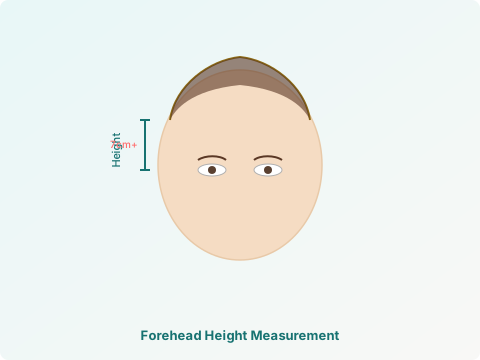
Forehead measurement
The surgeon measures the forehead height, evaluates scalp laxity, and determines how far the hairline can be safely advanced (typically 1-3 cm).
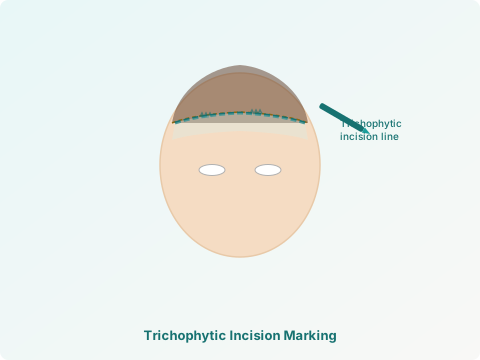
Trichophytic incision
An irregular, beveled incision is made along the existing hairline. This trichophytic technique allows hair to grow through the scar, concealing it.
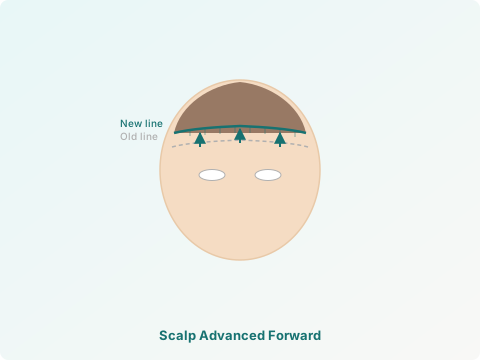
Scalp advancement
The scalp is undermined and advanced forward to the new, lower hairline position. Excess forehead skin between the old and new line is excised.
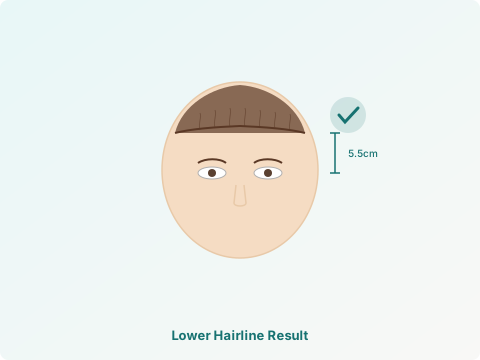
Tension-free closure
Deep galeal sutures bear the tension, allowing the skin to be closed without excessive pull. Hair growth through the scar line makes it nearly invisible.
Cost · as of 2026
Seoul Medical Insider provides fully transparent quotes for hairline lowering surgery with no markup. Your itemised estimate includes the surgeon's fee, anaesthesia, operating-room charges, and any supplementary hair transplantation along the hairline or temples.
Price variation comes down to the extent of advancement, whether galeal scoring or an endoscopic release is needed, and whether hair grafts are transplanted at the same time to refine the hairline shape. Despite offering some of the most technically skilled surgeons in the world, Korean clinics typically price hairline lowering at 40 – 60 % less than comparable procedures in North America or Europe.
Pricing is reviewed and updated for 2026. Reach out for a personalised consultation and quote.
Who it is for
Hairline lowering is a specialised procedure. The following profiles help determine if it is the right option for you.
- Suited: Women with a naturally high forehead (typically > 6 – 7 cm from brow to hairline) who want a shorter, more balanced forehead proportion.
- Suited: Patients with good scalp laxity — the scalp must be loose enough to advance without excessive tension. A simple "pinch test" during consultation helps assess this.
- Suited: Those who want a permanent, one-session solution as opposed to years of hair-transplant sessions to fill in the frontal area.
- Suited: Patients planning to combine the procedure with brow lift or forehead contouring for comprehensive upper-face harmony.
- Discuss carefully: Individuals with active androgenetic alopecia (pattern baldness), as further hair loss behind the new hairline may create an unnatural gap over time.
- Discuss carefully: Patients with very tight scalps — limited laxity restricts how far the hairline can advance and increases scar tension.
- Discuss carefully: Those who wear their hair very short, as the fine scar along the hairline may be more visible.
Recovery
- Week 1. Forehead swelling and tightness are most pronounced in the first 3 – 5 days and can extend to the brow and upper eyelids. Mild bruising around the eyes is common. Sutures or staples remain in place. Sleep with your head elevated at 30 – 45 degrees.
- Weeks 2 – 3. Sutures/staples are removed around day 10 – 14. Swelling diminishes significantly. Numbness behind the hairline is normal and gradually resolves. Light desk work can resume once sutures are out.
- Weeks 4 – 8. The scar line is still pink but can be concealed with hair styling or a thin headband. Light exercise resumes at week 4; avoid contact sports and heavy straining until week 6 – 8.
- Months 3 – 12. The scar matures from pink to white and becomes increasingly hidden as hair grows through the trichophytic incision line. Final forehead proportions are fully apparent.
Plan a stay of at least 10 – 14 days in Seoul to cover suture removal and a follow-up evaluation. Seoul Medical Insider can recommend nearby accommodation and help you schedule your appointments efficiently.
Risks & considerations
Hairline lowering is considered safe when performed by a skilled surgeon, but potential risks include numbness or altered sensation behind the hairline (usually temporary, lasting weeks to months), a widened or visible scar (mitigated by trichophytic closure and low-tension repair), hair loss (shock loss) around the incision — typically temporary, wound infection, asymmetric hairline position, and excessive scar tension if scalp laxity was overestimated. In rare cases, revision surgery or scar-camouflage hair transplantation may be needed. Patients with a history of keloid scarring should discuss this carefully with their surgeon.
Korea trip checklist
- Share clear photos of your hairline (frontal, oblique, and top-down views) during your Seoul Medical Insider video consultation so the surgeon can assess your anatomy remotely.
- Discontinue blood-thinning medications and supplements (aspirin, ibuprofen, fish oil, vitamin E) at least 2 weeks before surgery.
- Stop smoking at least 4 weeks prior — nicotine restricts blood flow to the scalp and can impair healing along the incision.
- Pack loose headbands, wide-brimmed hats, and button-front tops. Avoid anything that pulls tightly over the forehead.
- Arrange accommodation within easy reach of the clinic for the first 10 – 14 days; you will need multiple follow-up visits for wound checks and suture removal.
- Bring a neck pillow or wedge pillow to help you sleep in an elevated position during the first week.
- Carry a printed surgical summary and your surgeon's contact information in English for continuity of care at home.
Clinical details are summarized from materials provided by SMI's partner clinics and published guidance from the Korean Society of Plastic and Reconstructive Surgeons (KSPRS). Technique selection is determined by your surgeon during consultation. SMI is a registered patient-facilitation agency, not a medical provider, and does not offer medical advice.
Why get this procedure in Korea
-
Pioneering anti-aging techniques
Korean surgeons are recognised for advanced SMAS and deep-plane techniques that deliver natural, long-lasting results.
-
Comprehensive aftercare
Clinics offer structured recovery programs including LED therapy, lymphatic drainage, and scheduled follow-ups before you fly home.
-
Significant cost advantage
Anti-aging procedures in Korea cost 40-60% less than in Western countries, even at premium clinics with the latest equipment.
You may also consider
Related guides
- Ponytail Lift in Korea: A Guide to Endoscopic Brow and Midface Lifting for International Patients The ponytail lift is a minimally invasive endoscopic approach to brow and midface rejuvenation. Here is what international patients should know about candidacy, costs, longevity, and planning a trip to Korea.
- How Long Should You Stay in Korea After Plastic Surgery? A logistics hub for international patients — typical recovery-stay windows by procedure, when you can safely fly home, and the visa and interpreter basics for a trip to Seoul.
- Is Plastic Surgery in Korea Safe? A Patient's Guide to Avoiding Ghost Surgery A balanced look at safety in Korea's plastic surgery industry — what ghost surgery is, the laws that protect you, and the checks every international patient should make before booking.
Frequently asked questions
Sources
- Ministry of Health and Welfare, Republic of Korea
- Medical Korea (KHIDI)
- Korea Health Industry Development Institute (KHIDI)
- Korean Society of Plastic and Reconstructive Surgeons (KSPRS)
- International Society of Aesthetic Plastic Surgery (ISAPS)
Read our editorial policy to learn how we source and verify information.
