
Procedure guide
Angular Jaw Correction in Korea
- Surgery time Around 1 – 1.5 hours
- Anesthesia type General anesthesia
- Hospitalization 1 night
- Face wash & makeup 3 days after surgery
- Post-surgery check-up 2 times (depending on the patient's condition)
- Stitches removal 14 days after surgery



Angular jaw correction — also called mandibular angle reduction or V-line jaw surgery — reshapes the lower jaw by trimming the prominent bony angle at the rear of the mandible. The goal is a softer, narrower jawline that transitions smoothly from the chin to the ear. Korea is widely recognised as a global leader in this procedure, with oral-maxillofacial and plastic surgeons performing thousands of cases each year using advanced reciprocating-saw and piezoelectric techniques.
For international patients, Seoul clinics offer 3-D CT planning, real-time nerve-monitoring equipment, and multilingual coordination teams that simplify every step from consultation to aftercare.
| Surgery time | 1.5 – 2.5 hours |
|---|---|
| Anaesthesia | General anaesthesia |
| Hospital stay | 1 night (occasionally 2) |
| Back to routine | 2 – 3 weeks |
| Final result | 3 – 6 months |
The information on this page is for educational purposes and does not replace a professional medical consultation. Individual anatomy, health status, and surgical goals vary — always consult a qualified surgeon before making decisions.
How it works
Angular jaw surgery is performed entirely through incisions inside the mouth, leaving no visible scars on the face. The surgeon accesses the mandibular angle from within the oral cavity and reshapes the bone to create a slimmer profile.
- Planning — A 3-D CT scan maps the exact bone thickness, nerve canal position, and ideal resection line. The surgeon designs the new jawline digitally before the operation begins.
- Anaesthesia — General anaesthesia is administered. An endotracheal tube is placed through the nose to keep the mouth clear for the surgeon.
- Access — A 3–4 cm incision is made along the inner gum line behind the lower molars on each side. The periosteum is elevated to expose the mandibular angle and body.
- Reshaping — Using a reciprocating or oscillating saw (often guided by piezoelectric technology to protect the inferior alveolar nerve), the surgeon removes the protruding angle. In many cases a long-curve osteotomy is performed, extending the cut forward along the lower border for a smooth, continuous V-line rather than an abrupt step.
- Closing — The periosteum and mucosa are sutured in layers with absorbable stitches. A compressive facial bandage is applied to minimise swelling and support the new contour.
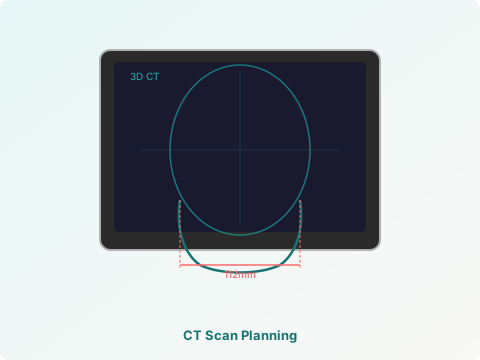
3D CT planning
A 3D CT scan maps the jaw angle anatomy, nerve canal location, and masseter muscle attachment. The surgeon designs precise resection lines for optimal slimming.
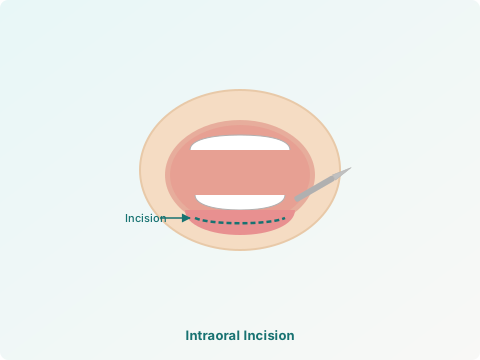
Intraoral access
An incision inside the mouth along the lower gumline provides direct access to the jaw angle bone, leaving no visible external scars.
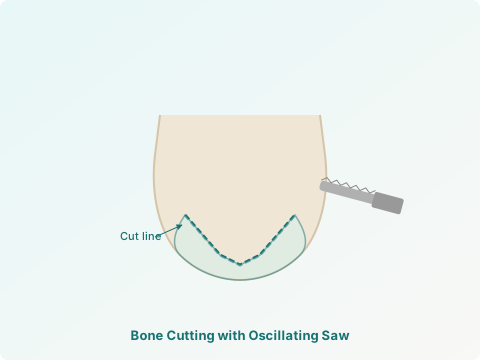
Bone resection & contouring
The protruding jaw angle is resected with an oscillating saw, then the remaining bone edge is smoothed with a burr for a naturally rounded contour.
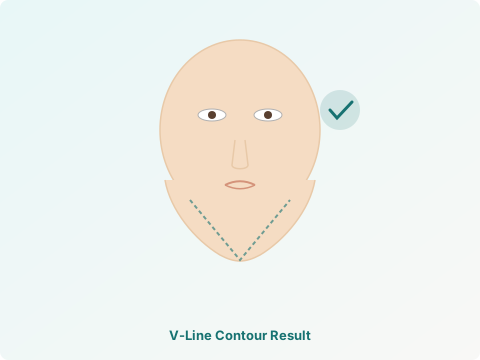
Compression & healing
A compression bandage is applied immediately to reduce swelling. The intraoral incision is closed with dissolvable sutures. Soft diet is required for 2 weeks.
Cost · as of 2026
Through Seoul Medical Insider there are no hidden agency fees or inflated pricing. We connect you directly with board-certified surgeons at transparent, locally quoted rates so you pay what Korean patients pay — nothing more.
Angular jaw reduction in Korea typically ranges from KRW 4,000,000 to KRW 8,000,000 (approximately USD 3,000 – 6,000). The final price depends on the extent of bone removal, whether additional chin or cortical osteotomy work is included, the hospital tier, and the individual surgeon's experience. Combined V-line packages (jaw angle + chin) may cost more but are often priced favourably compared with booking each procedure separately.
All pricing information is reviewed and updated as of 2026. Please request a personalised quote through Seoul Medical Insider for the most current figures.
Who it is for
Angular jaw surgery can dramatically change facial proportions, so candidacy depends on both anatomy and expectations.
- Suited: Adults with a wide, square jawline caused by a prominent mandibular angle who desire a slimmer, V-shaped lower face.
- Suited: Patients whose jaw width is primarily bony rather than muscular (masseter Botox alone has not achieved the desired result).
- Suited: Individuals in good general health with no active dental infections or untreated temporomandibular joint (TMJ) disorders.
- Discuss carefully: Patients with significant facial asymmetry — corrective jaw surgery may be more appropriate than cosmetic angle reduction alone.
- Discuss carefully: Those with thin soft-tissue coverage over the jaw, as post-operative contour irregularities may be more visible.
- Discuss carefully: Patients who grind their teeth heavily (bruxism), as masseter hypertrophy may partially return and alter the aesthetic outcome.
Recovery
- Week 1 — Significant swelling and bruising, especially around the lower face and neck. A liquid-to-soft diet is required. A compression garment is worn around the clock. Mild to moderate pain is managed with prescribed medication. Stitches inside the mouth are absorbable.
- Weeks 2 – 3 — Swelling begins to subside noticeably. Most patients can switch to a soft-solid diet. Bruising fades. Light daily activities and desk work can resume toward the end of this period.
- Weeks 4 – 8 — Around 70 – 80 % of swelling has resolved. Patients may return to moderate exercise. Numbness in the lower lip or chin area (common due to nerve proximity) continues to improve gradually.
- Months 3 – 12 — Residual deep swelling resolves and the final jawline shape becomes apparent. Full nerve sensation typically returns within 6 – 12 months, though minor areas of reduced sensitivity can persist longer in some cases.
International patients should plan to stay in Seoul for at least 7 – 10 days after surgery. This allows for the initial check-up, suture assessment, and management of any early complications before flying home.
Risks & considerations
Angular jaw surgery is generally safe when performed by an experienced surgeon, but all bone-contouring procedures carry inherent risks. These include temporary or, rarely, permanent numbness of the lower lip and chin due to inferior alveolar nerve injury; post-operative bleeding or haematoma requiring drainage; infection at the surgical site; asymmetric bone removal leading to an uneven jawline; contour irregularities or a visible step-off if the osteotomy line is not smoothly blended; sagging of soft tissue over the reduced bone (ptosis), particularly in older patients with less skin elasticity; damage to tooth roots near the osteotomy line; and, in extremely rare cases, mandibular fracture during or after surgery. Choosing a surgeon with extensive facial-bone experience and ensuring proper 3-D CT planning significantly reduces these risks.
Korea trip checklist
- Obtain a recent panoramic dental X-ray and 3-D CT scan — many Korean clinics accept files digitally for a remote pre-consultation.
- Disclose all medications, supplements, and herbal remedies; stop blood-thinning agents (aspirin, omega-3, vitamin E) at least two weeks before surgery as directed.
- Arrange accommodation within 30 minutes of the clinic for the first week; you will need to attend follow-up visits.
- Stock up on a liquid and soft-food supply — protein shakes, congee, and pureed soups are staples during early recovery.
- Pack a compression face garment (or confirm the clinic provides one) and a few cold-pack wraps for swelling control.
- Plan a minimum stay of 7 – 10 days in Korea before your return flight; flying too early increases swelling risk due to cabin pressure changes.
- Confirm your travel insurance covers elective surgery complications abroad, or purchase a supplementary policy.
Clinical details are summarized from materials provided by SMI's partner clinics and published guidance from the Korean Society of Plastic and Reconstructive Surgeons (KSPRS). Technique selection is determined by your surgeon during consultation. SMI is a registered patient-facilitation agency, not a medical provider, and does not offer medical advice.
Why get this procedure in Korea
-
World-leading surgical volume
Korean plastic surgeons perform more facial procedures per capita than any other country, refining techniques through high case volumes.
-
Board-certified specialists
All SMI partner surgeons hold Korean Board of Plastic Surgery certification and operate at JCI or KOIHA-accredited facilities.
-
40-60% cost savings
Comparable or superior results at a fraction of US/EU pricing, with no compromise on safety standards or technology.
You may also consider
Related guides
- V-Line Jaw Reduction Surgery in Korea: Candidacy, Methods, Recovery, and Safety for International Patients V-line jaw reduction is one of Korea's most sought-after facial contouring procedures. This guide covers who qualifies, how the surgery works, what recovery looks like, and how international patients can navigate the process safely.
- V-Line & Jaw Reduction Surgery in Korea: A Complete Cost & Safety Guide A clear guide to V-line and jaw reduction surgery in Korea: what it is, cost factors, recovery, and the safety checks bone surgery demands.
- How Long Should You Stay in Korea After Plastic Surgery? A logistics hub for international patients — typical recovery-stay windows by procedure, when you can safely fly home, and the visa and interpreter basics for a trip to Seoul.
- The Real All-In Cost of Plastic Surgery in Korea (Beyond the Quote) The surgery quote is only part of the bill. A clear, honest framework for the all-in cost of plastic surgery in Korea — every line item, plus how to avoid hidden fees and the foreigner price gap.
Frequently asked questions
Sources
- Ministry of Health and Welfare, Republic of Korea
- Medical Korea (KHIDI)
- Korea Health Industry Development Institute (KHIDI)
- Korean Society of Plastic and Reconstructive Surgeons (KSPRS)
- International Society of Aesthetic Plastic Surgery (ISAPS)
Read our editorial policy to learn how we source and verify information.
