
Procedure guide
Zygoma (Cheekbone) Reduction in Korea
- Surgery time Around 1 – 1.5 hours
- Anesthesia type General anesthesia
- Hospitalization 1 night
- Face wash & makeup 14 days after surgery
- Post-surgery check-up 2 times (depending on the patient's condition)
- Stitches removal 14 days after surgery



Zygoma reduction surgery — commonly called cheekbone reduction — narrows and flattens prominent cheekbones by repositioning or trimming the zygomatic bone and arch. Wide or protruding cheekbones can make the midface appear broad; this procedure brings the cheekbones inward to create a smoother, more oval facial silhouette. South Korea is one of the few countries where this operation is performed routinely, giving Korean surgeons an unmatched volume of experience with the technique.
International patients benefit from Korea's advanced 3-D imaging, specialised facial-contouring clinics, and streamlined care coordination — from initial CT analysis to post-operative recovery support.
| Surgery time | 1.5 – 2 hours |
|---|---|
| Anaesthesia | General anaesthesia |
| Hospital stay | 1 night |
| Back to routine | 2 – 3 weeks |
| Final result | 3 – 6 months |
The information on this page is for educational purposes and does not replace a professional medical consultation. Individual anatomy, health status, and surgical goals vary — always consult a qualified surgeon before making decisions.
How it works
Zygoma reduction involves cutting the zygomatic bone at strategic points and repositioning the segments inward. The most common method in Korea is the L-shaped osteotomy combined with an arch infracture, which achieves a natural, three-dimensional narrowing rather than simple shaving.
- Planning — A 3-D CT scan is used to measure cheekbone projection, arch width, and bone thickness. The surgeon determines the osteotomy design and the millimetres of inward movement needed.
- Anaesthesia — General anaesthesia is administered via nasotracheal intubation to keep the oral surgical field clear.
- Access — Two incision sites are used: a small incision inside the mouth (in the upper gum area above the molars) and a tiny incision in the sideburn hairline or temporal area to reach the zygomatic arch.
- Reshaping — The zygomatic body is cut (L-shaped or oblique osteotomy) through the intraoral incision, and the zygomatic arch is fractured or cut through the temporal incision. The freed bone segment is rotated and pushed inward, then fixed in its new position with titanium micro-plates and screws.
- Closing — Incisions are sutured with absorbable material inside the mouth and fine sutures in the hairline. A compression bandage is wrapped around the midface to control swelling and stabilise the repositioned bone.
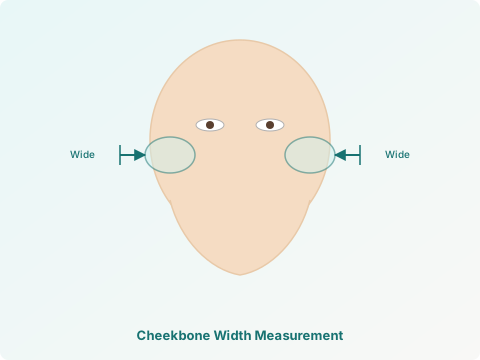
Cheekbone analysis
Using 3D CT imaging, the surgeon measures the degree of zygomatic arch protrusion and plans the osteotomy locations for harmonious midface narrowing.
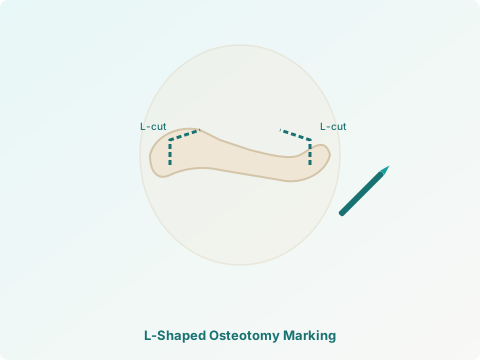
Dual-incision approach
Two small incisions — one intraoral and one in the temporal hairline — provide access to the front and rear of the zygomatic arch respectively.
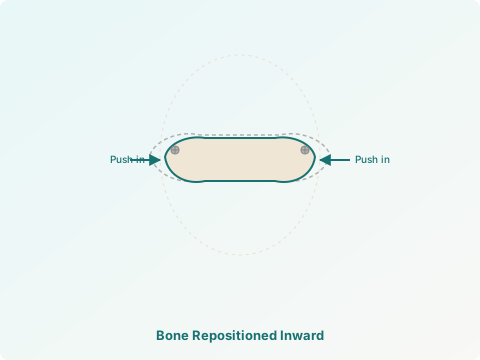
Bone fracture & inward rotation
The zygomatic arch is cut at both ends, then the freed bone segment is pushed inward and secured with titanium micro-plates to maintain the reduced position.
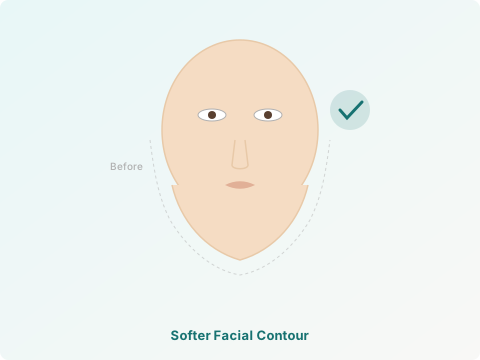
Recovery & settling
Facial compression minimises swelling. The new cheekbone contour becomes apparent at 4-6 weeks as swelling resolves, with final results at 3-6 months.
Cost · as of 2026
Seoul Medical Insider operates with full price transparency — no middleman mark-ups, no surprise fees. You receive the same rate the clinic offers its domestic patients, with a clear breakdown before you commit.
Zygoma reduction in Korea generally costs between KRW 4,500,000 and KRW 9,000,000 (approximately USD 3,400 – 6,800). Pricing varies based on the complexity of the osteotomy (simple arch infracture versus full L-osteotomy with plating), whether additional procedures such as jaw or chin contouring are performed at the same time, and the surgeon's level of specialisation. Combination facial-contouring packages are common and may offer better value.
All pricing information is reviewed and updated as of 2026. Contact Seoul Medical Insider for a personalised estimate based on your CT scan and goals.
Who it is for
Cheekbone reduction is a highly specialised procedure best suited for specific facial anatomies and clearly defined aesthetic goals.
- Suited: Adults with laterally protruding zygomatic arches that create a wide midface, and who desire a narrower, more oval facial contour.
- Suited: Patients whose cheekbone prominence is skeletal rather than caused by soft-tissue fullness (buccal fat or malar fat pads).
- Suited: Individuals with realistic expectations who understand the bone is being repositioned, not simply shaved, and that subtle asymmetries may persist.
- Discuss carefully: Patients with very thin soft tissue — the repositioned bone edges may be palpable or visible after swelling resolves.
- Discuss carefully: Those with pre-existing midface sagging, as removing skeletal support can worsen ptosis; a simultaneous lift procedure may be needed.
- Discuss carefully: Patients with sinusitis or active dental infections in the upper jaw, as the osteotomy site is near the maxillary sinus.
Recovery
- Week 1 — Pronounced midface swelling and bruising that may extend to the lower eyelids. A compression garment is worn continuously. Diet is limited to liquids and very soft foods. Pain is moderate and controlled with oral medication.
- Weeks 2 – 3 — Swelling reduces significantly; bruising turns yellow-green and fades. Patients can transition to a soft diet. Light activities and indoor walking are encouraged. The compression garment may be worn at night only.
- Weeks 4 – 8 — Most social swelling has resolved, though the cheek area may still feel firm. Patients can resume moderate exercise. Numbness in the cheek or upper lip area gradually improves.
- Months 3 – 12 — Deep tissue swelling fully resolves, revealing the final cheekbone contour. Titanium plates are permanent but rarely cause issues; removal is only needed if they become symptomatic.
Plan to remain in Seoul for at least 7 – 10 days post-surgery. Early follow-up appointments are critical to check plate position and ensure proper healing of both the intraoral and temporal incisions.
Risks & considerations
Zygoma reduction is considered safe in experienced hands, but potential complications include temporary or prolonged numbness in the cheek and upper lip area due to infraorbital nerve irritation; asymmetric reduction if one side shifts differently during healing; soft-tissue sagging (midface ptosis) from loss of skeletal support, particularly in patients over 40; infection around the fixation plates requiring antibiotics or, rarely, plate removal; non-union or delayed union at the osteotomy site; palpable or visible plate edges under thin skin; haematoma or seroma in the temporal region; trismus (limited mouth opening) during the early recovery phase; and, in rare cases, damage to the maxillary sinus lining causing sinusitis. Meticulous surgical technique and precise 3-D planning are the best safeguards against these risks.
Korea trip checklist
- Request a 3-D CT scan before departure or arrange one at the Korean clinic — it is essential for surgical planning.
- Stop all blood-thinning medications and supplements (aspirin, ibuprofen, fish oil, ginkgo) at least two weeks prior to surgery.
- Book accommodation close to your clinic for the first 7 – 10 days; you will need multiple post-operative visits.
- Prepare soft foods and a blender — your diet will be restricted for the first two weeks. Korean pharmacies also stock meal-replacement drinks.
- Bring a wide, adjustable compression wrap or confirm one will be provided by the clinic.
- Avoid scheduling your return flight within the first 10 days; cabin pressure changes can aggravate facial swelling.
- Verify that your travel or health insurance includes coverage for complications from elective surgery abroad.
Clinical details are summarized from materials provided by SMI's partner clinics and published guidance from the Korean Society of Plastic and Reconstructive Surgeons (KSPRS). Technique selection is determined by your surgeon during consultation. SMI is a registered patient-facilitation agency, not a medical provider, and does not offer medical advice.
Why get this procedure in Korea
-
World-leading surgical volume
Korean plastic surgeons perform more facial procedures per capita than any other country, refining techniques through high case volumes.
-
Board-certified specialists
All SMI partner surgeons hold Korean Board of Plastic Surgery certification and operate at JCI or KOIHA-accredited facilities.
-
40-60% cost savings
Comparable or superior results at a fraction of US/EU pricing, with no compromise on safety standards or technology.
You may also consider
Related guides
- V-Line Jaw Reduction Surgery in Korea: Candidacy, Methods, Recovery, and Safety for International Patients V-line jaw reduction is one of Korea's most sought-after facial contouring procedures. This guide covers who qualifies, how the surgery works, what recovery looks like, and how international patients can navigate the process safely.
- Is Plastic Surgery in Korea Safe? A Patient's Guide to Avoiding Ghost Surgery A balanced look at safety in Korea's plastic surgery industry — what ghost surgery is, the laws that protect you, and the checks every international patient should make before booking.
- How Long Should You Stay in Korea After Plastic Surgery? A logistics hub for international patients — typical recovery-stay windows by procedure, when you can safely fly home, and the visa and interpreter basics for a trip to Seoul.
- The Real All-In Cost of Plastic Surgery in Korea (Beyond the Quote) The surgery quote is only part of the bill. A clear, honest framework for the all-in cost of plastic surgery in Korea — every line item, plus how to avoid hidden fees and the foreigner price gap.
Frequently asked questions
Sources
- Ministry of Health and Welfare, Republic of Korea
- Medical Korea (KHIDI)
- Korea Health Industry Development Institute (KHIDI)
- Korean Society of Plastic and Reconstructive Surgeons (KSPRS)
- International Society of Aesthetic Plastic Surgery (ISAPS)
Read our editorial policy to learn how we source and verify information.
