
Procedure guide
Mid-Face Lift in Korea
- Surgery time Around 1 – 2 hours
- Anesthesia type General anesthesia
- Hospitalization 1 night
- Face wash & makeup 7 – 10 days after surgery
- Post-surgery check-up 2 times (depending on the patient's condition)
- Stitches removal 7 – 10 days after surgery


A mid-face lift targets the area between the lower eyelids and the upper lip — the region that often shows the earliest signs of ageing. As the malar fat pad descends with time, patients develop deepening nasolabial folds, flattened cheeks, and a tired appearance that skincare alone cannot reverse. Korean plastic surgeons have refined sub-periosteal and SMAS-based mid-face techniques that restore youthful cheek volume and smooth the transition between the lower lid and the cheek with minimal visible scarring.
Korea is a global leader in facial rejuvenation surgery, with high-volume clinics that combine mid-face lifting with fat grafting or lower-blepharoplasty in a single session. International patients benefit from competitive pricing, advanced anaesthesia protocols, and surgeons who routinely perform hundreds of mid-face procedures each year.
| Surgery time | 1.5 – 2.5 hours |
| Anaesthesia | General or IV sedation with local |
| Hospital stay | Day surgery or 1 night |
| Back to routine | 10 – 14 days |
| Final result | 3 – 6 months |
This page is for informational purposes only and does not replace a professional medical consultation. Individual results vary depending on anatomy, health status, and surgical plan.
How it works
The mid-face lift repositions descended soft tissue back to its youthful position over the cheekbone. Several approaches exist; your surgeon will choose based on the degree of sagging and whether concurrent procedures are planned.
- Planning. Pre-operative facial analysis maps the malar fat pad position, skin elasticity, and any asymmetry. Photographs and sometimes 3-D imaging guide the surgical plan.
- Anaesthesia. General anaesthesia is most common, though IV sedation with local infiltration is used for less extensive cases.
- Access. Incisions are typically placed inside the lower eyelid (transconjunctival) and/or at the temple hairline. In the sub-periosteal technique the surgeon lifts tissue from just above the bone; in the SMAS approach the deeper muscular layer is repositioned.
- Repositioning. The malar fat pad and surrounding soft tissue are elevated and secured to the deep temporal fascia or periosteum with absorbable sutures or endotine devices. Fat grafting may be added to restore volume in hollow areas.
- Closing. Incisions are closed in layers with fine sutures. Mild compression dressings are applied to minimise swelling.
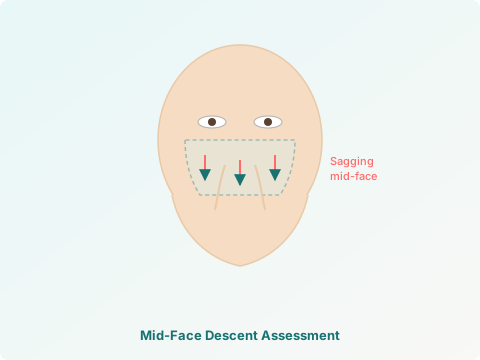
Mid-face assessment
The surgeon evaluates the degree of cheek descent, nasolabial fold depth, and malar fat pad position to plan the optimal lifting vector.
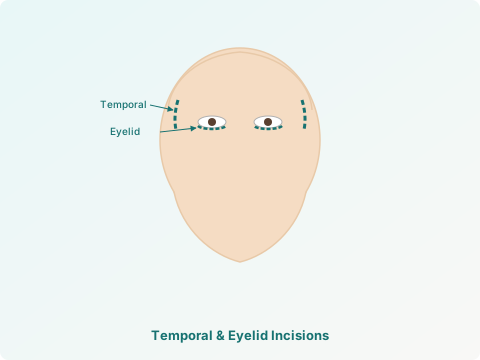
Incision & tissue release
Through a lower eyelid or temporal incision, the surgeon releases the mid-face soft tissues from the underlying bone, freeing them for vertical repositioning.
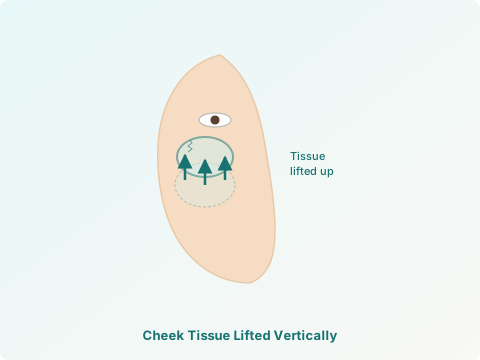
Vertical lift & fixation
The descended cheek fat pad and soft tissue are lifted vertically and secured with deep sutures, restoring youthful cheek fullness and reducing nasolabial folds.
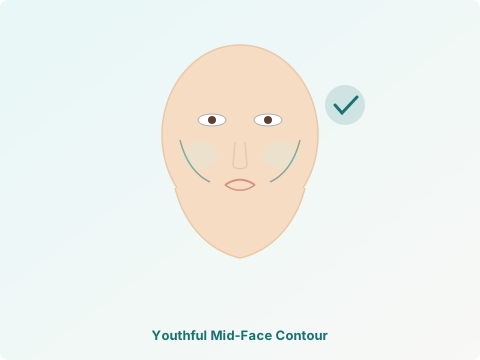
Closure & recovery
Incisions are closed in concealed locations. Moderate swelling lasts 2-3 weeks. The restored mid-face volume gives a naturally rejuvenated appearance.
Cost · as of 2026
Through Seoul Medical Insider, mid-face lift surgery in Korea is arranged with no markup and fully transparent pricing. You receive an itemised quote covering the surgeon's fee, anaesthesia, facility charges, and any combined procedures such as fat grafting or lower blepharoplasty — so there are no hidden costs.
The total price depends on the technique used (sub-periosteal vs. SMAS), whether the procedure is combined with other facial rejuvenation steps, and the surgeon's experience level. In Korea, mid-face lift costs are typically 40 – 60 % lower than equivalent procedures in the United States, Europe, or Australia, even at top-tier clinics.
Pricing information is reviewed and updated for 2026. Contact us for a personalised quote based on your goals and anatomy.
Who it is for
A mid-face lift addresses a specific zone of facial ageing. Knowing whether you are a strong candidate helps set realistic expectations.
- Suited: Adults aged 35 – 60 with noticeable cheek descent, deepened nasolabial folds, and loss of midface volume despite good skin quality.
- Suited: Patients who want a natural, refreshed look rather than the pulled appearance sometimes associated with traditional facelifts.
- Suited: Those combining the mid-face lift with lower blepharoplasty or fat grafting for comprehensive periorbital and cheek rejuvenation.
- Discuss carefully: Heavy smokers — smoking impairs blood supply to elevated tissue and increases the risk of complications.
- Discuss carefully: Patients with significant jowling or neck laxity — a full facelift or lower facelift may be more appropriate.
- Discuss carefully: Those with unrealistic expectations of looking decades younger from a single procedure.
Recovery
- Week 1. Moderate swelling and bruising concentrated around the cheeks and lower eyelids. Cold compresses and head elevation are essential. Sutures or tapes around the eyes are removed at 5 – 7 days.
- Weeks 2 – 3. Most bruising fades and swelling reduces noticeably. Patients can return to desk work and light social activities. Avoid bending forward or heavy lifting.
- Weeks 4 – 8. Residual firmness in the cheek area gradually softens. Light exercise can resume around week 4; strenuous activity after week 6.
- Months 3 – 12. Tissues settle into their final position. Scars hidden in the hairline and inside the eyelid mature and become virtually invisible.
International patients should plan to stay in Seoul for at least 7 – 10 days after surgery. This allows for initial recovery checks, suture removal, and clearance to fly. Seoul Medical Insider can help coordinate accommodation near your clinic.
Risks & considerations
Mid-face lift surgery is generally safe when performed by an experienced surgeon, but all procedures carry risks. Possible complications include haematoma (blood collection under the skin), temporary or rarely persistent numbness of the cheek, asymmetry in fat-pad positioning, lower-eyelid retraction or ectropion (especially when combined with blepharoplasty), infection, prolonged swelling, and visible or hypertrophic scarring. Damage to branches of the facial nerve is rare but can cause temporary weakness of smile muscles. Discuss your complete medical history and any blood-thinning medications with your surgeon during the consultation.
Korea trip checklist
- Book a video consultation through Seoul Medical Insider at least 4 – 6 weeks before your trip to confirm candidacy and surgical plan.
- Stop aspirin, ibuprofen, fish oil, and vitamin E supplements at least 2 weeks before surgery to reduce bleeding risk.
- Arrange accommodation within 15 minutes of the clinic for the first week — you will need easy access for follow-up visits.
- Pack button-front shirts to avoid pulling clothing over your face. Bring a travel pillow for sleeping in an elevated position.
- Prepare soft foods (porridge, soup, smoothies) for the first few days, as chewing may be uncomfortable.
- Confirm your return flight is no earlier than 7 days post-surgery; your surgeon must clear you to fly.
- Carry your surgical summary and surgeon's contact details in English for any medical follow-up in your home country.
Clinical details are summarized from materials provided by SMI's partner clinics and published guidance from the Korean Society of Plastic and Reconstructive Surgeons (KSPRS). Technique selection is determined by your surgeon during consultation. SMI is a registered patient-facilitation agency, not a medical provider, and does not offer medical advice.
Why get this procedure in Korea
-
Pioneering anti-aging techniques
Korean surgeons are recognised for advanced SMAS and deep-plane techniques that deliver natural, long-lasting results.
-
Comprehensive aftercare
Clinics offer structured recovery programs including LED therapy, lymphatic drainage, and scheduled follow-ups before you fly home.
-
Significant cost advantage
Anti-aging procedures in Korea cost 40-60% less than in Western countries, even at premium clinics with the latest equipment.
You may also consider
Related guides
- Full Facelift in Korea: A Complete Guide for International Patients in 2026 Full facelift in Seoul, 2026: techniques, surgeon credentials, cost ranges, recovery timeline, and how international patients book safely with SMI.
- Ponytail Lift in Korea: A Guide to Endoscopic Brow and Midface Lifting for International Patients The ponytail lift is a minimally invasive endoscopic approach to brow and midface rejuvenation. Here is what international patients should know about candidacy, costs, longevity, and planning a trip to Korea.
- Fat Grafting in Korea: What International Patients Should Know About Fat Transfer Procedures Korea has become a leading destination for fat grafting procedures, from facial rejuvenation to breast and body contouring. This guide covers what international patients need to know about techniques, costs, recovery, and choosing a qualified surgeon.
- How Long Should You Stay in Korea After Plastic Surgery? A logistics hub for international patients — typical recovery-stay windows by procedure, when you can safely fly home, and the visa and interpreter basics for a trip to Seoul.
Frequently asked questions
Sources
- Ministry of Health and Welfare, Republic of Korea
- Medical Korea (KHIDI)
- Korea Health Industry Development Institute (KHIDI)
- Korean Society of Plastic and Reconstructive Surgeons (KSPRS)
- International Society of Aesthetic Plastic Surgery (ISAPS)
Read our editorial policy to learn how we source and verify information.
