
Full Facelift in Korea: A Complete Guide for International Patients in 2026
Full facelift in Seoul, 2026: techniques, surgeon credentials, cost ranges, recovery timeline, and how international patients book safely with SMI.

Researching the treatment itself? Read our full procedure guide — cost, recovery, candidacy and risks.
Why are so many international patients flying to Korea for facelift surgery?
Because Seoul is known for precise techniques, natural-looking results, and long-lasting facial rejuvenation.
As a dedicated medical concierge service for international patients, we partner with Seoul's most established plastic surgery clinics — including board-certified specialists in Gangnam — to connect you with the right surgeon, manage every detail of your trip, and support you long after you fly home.
This guide walks you through everything you need to know before booking a Full Facelift in Korea.
Signs You May Be a Candidate for a Full Facelift
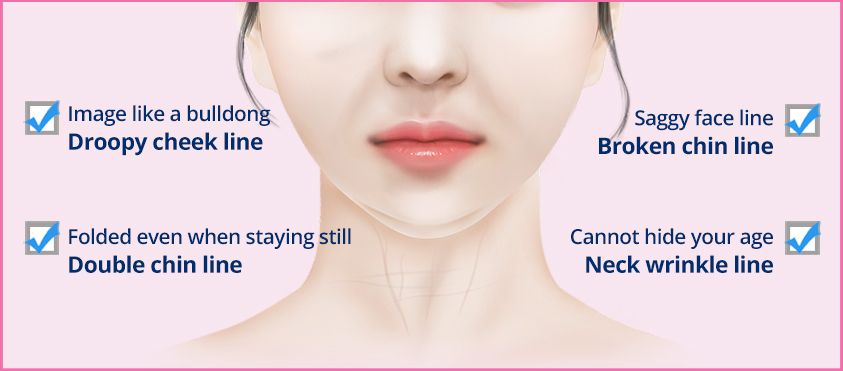
Before considering any surgical procedure, it helps to recognize the specific concerns a Full Facelift can address. Our partner surgeons commonly see international patients with one or more of the following:
✔ Droopy cheek line — heaviness along the jowls that creates a "bulldog" appearance
✔ Broken jawline — sagging that blurs the chin and jaw definition
✔ Double chin line — folds that remain visible even when your face is at rest
✔ Neck wrinkle lines — horizontal banding around the neck that adds visible age
If you recognize even one of these in the mirror, a Full Facelift may deliver a more transformative and lasting result than thread lifts, fillers, or non-surgical tightening alone.
What Is a Full Facelift?
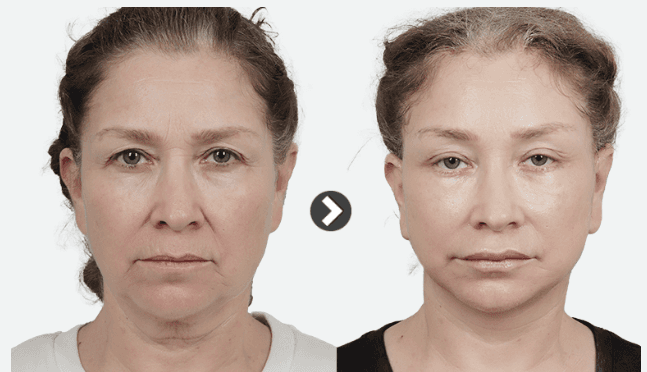
A Full Facelift is a comprehensive surgical procedure that improves deep facial wrinkles, sagging skin, and loss of definition by addressing both the skin and the underlying SMAS layer (the fibromuscular tissue beneath the skin).
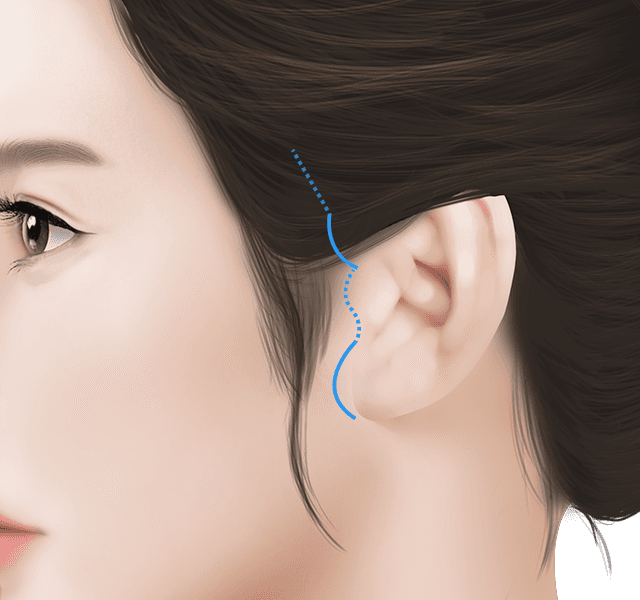
Through minimal incisions placed along the front of the ears and within the hairline, the surgeon removes excess stretched skin and re-suspends the deeper SMAS layer to restore youthful contours. Unlike thread lifts or laser treatments — which work primarily on the surface — a Full Facelift resets the underlying foundation of the face.
The result: a refreshed, naturally elegant appearance that doesn't look "pulled" or overdone.
Why International Patients Choose Korea for Facelift Surgery
Korea has built its global reputation in plastic surgery on three foundations: clinical volume, surgical precision, and accessible pricing. Here's what that means for you as an international patient:
1. Surgical Expertise Built on Volume
Top Seoul plastic surgeons perform facelifts on a weekly — sometimes daily — basis. That repetition translates directly into refined technique, shorter operating times, and more predictable outcomes than many Western clinics where facelift is a less frequent procedure.
2. Significant Cost Savings
Published figures for a full facelift in the United States or Canada vary widely once anesthesia, facility fees, and follow-up are included. The same procedure in Seoul — performed by a board-certified specialist at an accredited clinic — is typically lower, even when factoring in flights and accommodation. Rather than anchor on a single number, it helps to understand what actually drives the cost and to compare a complete all-in estimate against a complete quote at home.
3. Access to Advanced Endoscopic Techniques
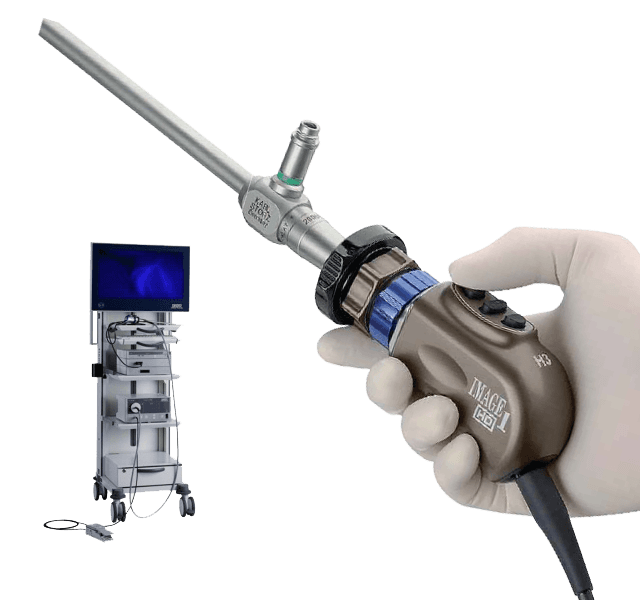
Many Korean clinics now use high-tech endoscopic visualization during facelift procedures. This allows surgeons to analyze tissue beneath the skin in real time, minimize collateral damage, and place incisions with millimeter precision.
4. Full-Service International Patient Support
This is the part most patients underestimate. Booking a clinic is only 10% of a successful surgical trip. The other 90% — visa support, airport pickup, English/Mandarin/Japanese interpretation, post-op care coordination, follow-up imaging review after you return home — is what determines whether your experience is smooth or stressful.
That's exactly what our concierge team handles end to end.
How a Full Facelift Can Transform Your Appearance
A skilled facelift surgeon doesn't just remove sagging skin — they redesign your facial image. During your consultation, the surgeon performs a precise analysis of your unique anatomy and discusses the appearance you'd like to achieve.
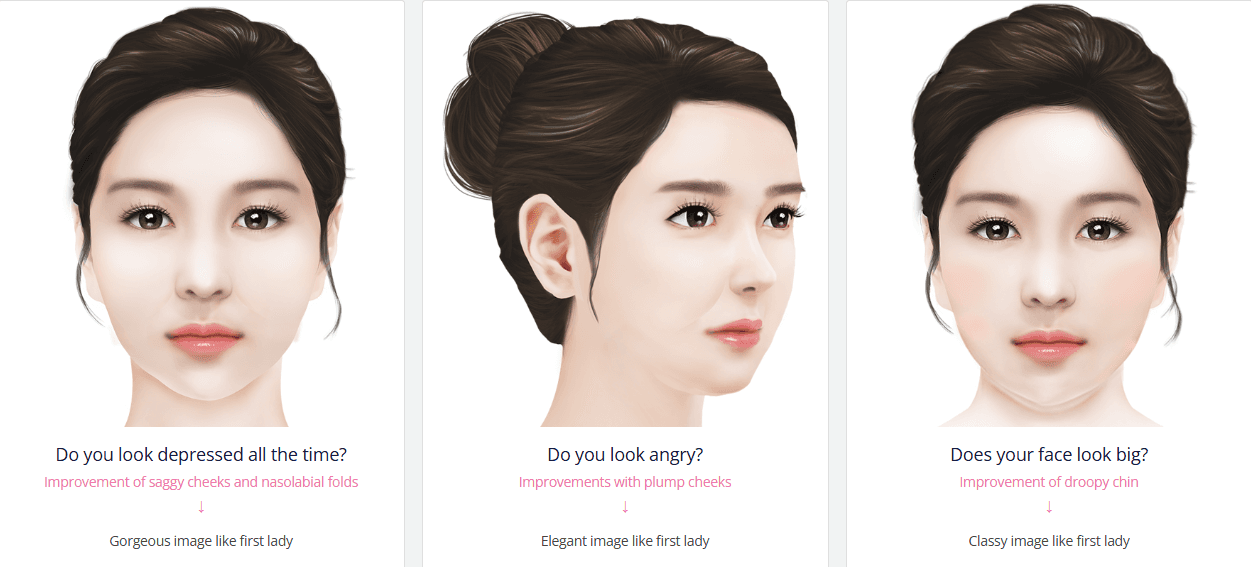
| Concern | Improvement | Resulting Image |
|---|---|---|
| Always look tired or "depressed" | Lifted cheeks, softened nasolabial folds | Bright, refreshed, approachable |
| Always look stern or angry | Restored cheek volume, softened mouth corners | Warm, gentle, composed |
| Face appears wider or heavier than it is | Tightened jowls, defined jawline | Slim, refined, age-appropriate |
The goal is never to chase a "different face." It's to restore the version of yourself that the mirror used to reflect a decade ago — only more refined.
Key Benefits of a Korean Full Facelift
Beautiful from Every Angle. Unlike treatments that only address frontal sagging, a Full Facelift produces visible improvement from the right profile, left profile, and front view. Your selfies, video calls, and in-person presence all benefit.
Long-Lasting Results from a Single Procedure. By suspending the SMAS layer in addition to the skin, a Full Facelift delivers durable results most patients describe as life-changing. While no surgery can stop aging entirely, properly performed SMAS facelifts typically maintain their primary effect for 10 years or more — far longer than threads or fillers.
Natural-Looking Lift. Korean facelift technique places strong emphasis on vector control — the direction in which tissue is repositioned. The objective is a face that looks rested and elegant, not surgically tightened.
Significant Reduction in Deep Wrinkles. Because the procedure addresses both layers of the face, it dramatically improves nasolabial folds, marionette lines, and deeper static wrinkles that don't respond to non-surgical treatment.
Advanced Surgical Techniques at Our Partner Clinics
Technique 01 — High-Definition Endoscopy
Surgeons use endoscopic visualization to map the tissue beneath your skin before making any incision. This minimizes nerve disruption, reduces bruising, and shortens recovery.
Technique 02 — Experienced Surgical Teams
Our partner clinics are staffed by plastic surgeons with thousands of facelift cases behind them. Refined incision and suturing technique means less bleeding, less pain, and no irregular contour or "bumpy skin" post-recovery.

Technique 03 — Hidden, Minimal Incisions
Incisions are made along the inner hairline and the frontal edge of the ear. Hairline incisions are concealed by your hair from day one. Pre-auricular incisions typically fade to near-invisibility within approximately three months.
Is a Full Facelift Right for You?
A Full Facelift is generally the most effective option for patients who:
Have moderate to advanced sagging of the cheeks, jawline, and neck
Have tried thread lifts, fillers, or laser treatments without satisfactory results
Want a single procedure with long-lasting results rather than maintenance every 6–12 months
Are in good general health and able to commit to approximately 2 weeks of recovery in Korea before flying home
If you have early-stage sagging, your consultation may instead recommend a less invasive procedure such as a mini-lift, deep-plane thread lifting, or Ultherapy. Our consultation team will be honest with you about what your anatomy actually needs.
Your Journey from Inquiry to Recovery
| Stage | Timeline | What We Handle |
|---|---|---|
| 1. Online Consultation | Day 1–7 | You send photos. We coordinate a video consultation with your matched surgeon and provide a personalized quote. |
| 2. Trip Planning | 2–4 weeks before travel | Visa documents, hotel near the clinic, airport pickup, interpreter assignment. |
| 3. Pre-Op Visit | Day 1 in Seoul | In-person consultation, bloodwork, surgical clearance, final design. |
| 4. Surgery Day | Day 2–3 | Full Facelift performed under general anesthesia. Overnight stay. |
| 5. In-Country Recovery | Day 4–14 | Daily check-ins, dressing changes, suture removal around day 10–14. |
| 6. Fly Home | Day 14+ | Final clearance from your surgeon. We provide a recovery kit and care instructions. |
| 7. Long-Term Follow-Up | 1, 3, 6, 12 months | Remote follow-up coordinated through our team — no need to fly back. |
Understanding the Real Cost — What's Actually in the Quote
Headline numbers are easy to compare and easy to misread. A surgery quote from one country can look cheaper than another purely because it leaves more out. The more useful question isn't "what's the price?" — it's "what does this price actually include, and what will I be billed for separately?"
Rather than chase a percentage, it helps to compare what's bundled. A coordinated Korea all-in plan and a typical Western surgeon's quote often draw the line in very different places:
| Cost factor | Korea all-in plan | A typical US/Western quote often… |
|---|---|---|
| Surgeon's fee | Included | Included |
| Anesthesia + anesthesiologist | Included | Quoted separately |
| Operating facility / hospital fee | Included | Quoted separately |
| Pre-op bloodwork & clearance | Included | Billed separately |
| Overnight monitoring | Included | Extra, if offered |
| Dressings, suture removal, check-ins | Included | Per-visit charges |
| Interpreter & coordinator | Included | Not applicable |
| Remote follow-up after you fly home | Included | Not applicable |
| Flights & accommodation | Your own budget line | Your own budget line |
What drives the surgeon's portion of the price also explains why two quotes for "a facelift" differ widely: the technique (a deep-plane dissection is more demanding than a skin-only lift), the surgeon's seniority and case volume, the extent of the lift, and whether you combine procedures in the same session.
For patients from the US, Canada, Singapore or Hong Kong, the practical takeaway is that the total cost in Seoul is typically meaningfully lower than an equivalent procedure at home — even after flights and a recovery stay — but the exact figure depends on your anatomy, your technique, and what you combine. We don't quote a flat number or a savings percentage online for that reason. The honest answer is to request a personalized quote after a photo review, so the figure reflects your case rather than an average.
Deep-Plane vs SMAS Facelift — How They Differ
The main section above describes the classic SMAS facelift, where the surgeon lifts the skin, then separately tightens and re-suspends the underlying SMAS layer. It's a well-established, durable approach. You may also hear surgeons discuss a deep-plane facelift, and it's worth understanding how the two differ so your consultation conversation is more productive.
The simplest way to think about it:
- SMAS facelift — the skin and the SMAS are addressed as separate layers. The skin is lifted first; the SMAS is then tightened, folded, or partially trimmed underneath. This gives the surgeon independent control over skin tension and deep-layer tension.
- Deep-plane facelift — the surgeon releases specific retaining ligaments and repositions the skin and SMAS together as a single composite unit, working in a deeper plane. Because the skin isn't pulled tight independently of the deeper tissue, the goal is a lift that relies on repositioning volume rather than skin tension.
Neither is universally "better" — they're tools suited to different faces. A deep-plane approach is often discussed for patients with heavier midface descent and deep nasolabial folds, where repositioning deeper tissue does more than tightening skin alone; a SMAS approach remains a versatile, reliable choice across a broad range of patients. Because the deep-plane technique is more technically demanding, surgeon experience matters more than the label. Ask your surgeon which technique they recommend for your anatomy and why — rather than requesting a technique by name because you read it online.
For patients with early or moderate sagging who don't yet need a full surgical lift, a less-invasive step-down such as a volume mini facelift may be discussed instead. And because the lower third of the face and the jaw-to-neck transition are so central to a balanced result, some patients exploring facial contour also review chin and lower-face options as part of the same profile assessment.
Complications, Revision & Satisfaction — Honestly
Any honest facelift guide has to talk about risk, not just results. Our position up front: Seoul Medical Insider is a facilitator, not a medical provider, and we do not publish complication rates, revision rates, or satisfaction statistics of our own. We'd be inventing numbers if we did — and inventing numbers in a medical context is exactly what you should distrust. What we can do is tell you which questions get you real, case-specific answers.
Questions to ask your surgeon directly:
- How many facelifts do you personally perform per year, and for how long? Volume and tenure are reasonable proxies for refined technique.
- What is your personal complication and revision rate, and how do you define it? A confident surgeon discusses their own outcomes rather than a generic figure.
- How do you handle a hematoma (a collection of blood under the skin) if one develops? This is the most common early facelift complication — you want a clear protocol.
- What is your approach if a nerve issue — temporary weakness or numbness — occurs? Most nerve effects are temporary, but you deserve to understand how they're managed.
- What does revision look like in your practice, and when is it considered? Results settle over months; ask how long the surgeon waits before discussing any touch-up.
General-anesthesia safety basics are just as important as the surgery itself. A full facelift is performed under general anesthesia, so confirm that a board-certified anesthesiologist manages your case, that the procedure takes place in an accredited facility equipped for it, and that overnight monitoring is provided after surgery — which the coordinated plans we work with include. These are standard, non-negotiable expectations, not premium add-ons. If you have any underlying health conditions, raise them early; your pre-op bloodwork and surgical clearance exist precisely to catch issues before the day of surgery. For a deeper walkthrough of operating-room standards, the operating-room CCTV law (effective 2023), and confirming your surgeon, see our guide to safe plastic surgery in Korea.
Combining Procedures in One Trip
A facelift addresses the lower face and jowls, but the features that read as "aging" rarely sit in one zone. That's why many international patients consider combining procedures in a single surgical visit. The two combinations most commonly discussed together are:
- Facelift + neck lift — the jawline and the neck age as a unit. Lifting the lower face while leaving a lax, banded neck untreated can create an imbalance, so the two are frequently planned together.
- Facelift + upper blepharoplasty — tired, hooded upper eyelids can make an otherwise refreshed lower face look incongruent. Adding an upper eyelid lift addresses the upper third of the face in the same session.
Why combine. For someone who has flown across the world, doing complementary procedures together means one anesthesia event, one recovery period, and one trip rather than two — and a result balanced across the whole face rather than refreshed in one area alone.
The trade-offs. Combining means a longer operation, more swelling, and a recovery that can feel more demanding in the first one to two weeks. There's also a limit to what's safe in a single session, set by your health, total operating time, and your surgeon's judgment — not by what you'd like to fit in. The right combination is the one your surgeon clears as safe for you, decided in consultation, never a fixed package.
A note on scope: this guide covers the facelift procedure itself — techniques, cost factors, risk questions, and how procedures combine. It does not cover how many days to stay in Korea or when it's safe to fly home; recovery stay-length and fly-home timing are covered in a separate dedicated recovery-stay guide, because the right answer depends on which procedures you combine and your surgeon's individual clearance.
Seoul Medical Insider works with accredited, government-registered partner clinics in Seoul — including NANA, Wonjin, Banobagi, and DA Plastic Surgery — and matches you to the right specialist for your case.
Disclaimer: All surgical procedures carry risk. Individual results vary. The information in this article is for general education and does not replace a personal consultation with a board-certified plastic surgeon. Recovery times, costs, and outcomes are estimates and depend on each patient's anatomy and chosen procedure.
Clinical details are summarized from materials provided by SMI's partner clinics and published guidance from the Korean Society of Plastic and Reconstructive Surgeons (KSPRS). Technique selection is determined by your surgeon during consultation. SMI is a registered patient-facilitation agency, not a medical provider, and does not offer medical advice.
Related procedure guide See the full Full Facelift (SMAS Rhytidectomy) guideFrequently asked questions
Sources
- Ministry of Health and Welfare, Republic of Korea
- Medical Korea (KHIDI)
- Korea Health Industry Development Institute (KHIDI)
- Korean Society of Plastic and Reconstructive Surgeons (KSPRS)
- International Society of Aesthetic Plastic Surgery (ISAPS)
Read our editorial policy to learn how we source and verify information.
