
Chin Surgery in Korea: A Complete Guide to Genioplasty for International Patients
Considering genioplasty in Korea? Costs, surgeon selection, recovery, and what international patients should expect at Seoul's top chin surgery clinics.

Researching the treatment itself? Read our full procedure guide — cost, recovery, candidacy and risks.
Are you considering chin surgery to enhance your facial profile? Korea has become the world's leading destination for genioplasty, attracting patients from the United States, Canada, Singapore, and beyond. As a medical tourism partner specializing in connecting international patients with top-tier Korean plastic surgery clinics, we've helped countless clients achieve natural, balanced results in Seoul — without the price tag of comparable procedures back home.
This guide will walk you through everything you need to know about chin surgery in Korea: the procedure types, how to choose the right approach, what to expect during your trip, and why so many North American and Southeast Asian patients are now choosing Seoul over their local options.
Why International Patients Choose Korea for Chin Surgery
Korea has earned its global reputation as the capital of facial contouring for several concrete reasons:
Specialized expertise. Korean facial bone surgeons perform genioplasty at far higher volumes than surgeons in most Western countries. Many top specialists focus exclusively on facial contouring, building deep technical experience.
Advanced techniques. From 3D CT-guided surgical planning to refined sliding genioplasty methods, Korean clinics consistently lead in surgical innovation for chin and jaw procedures.
Natural aesthetic philosophy. Korean facial contouring emphasizes harmony and proportion over dramatic transformation — a key reason international patients increasingly prefer Korean surgeons over those at home.
Significant cost advantage. Comparable genioplasty in Seoul is typically lower than in the U.S. or Canada, even after factoring in flights and accommodation — though the real number depends on your case, so we build an all-in estimate rather than quote a flat percentage.
Comprehensive aftercare infrastructure. Korean clinics serving international patients typically offer multilingual coordination, structured follow-up scheduling, and modern recovery facilities.
For patients from the U.S., Canada, and Singapore, the combination of surgical excellence and value is increasingly difficult to match locally.
What Is Genioplasty?
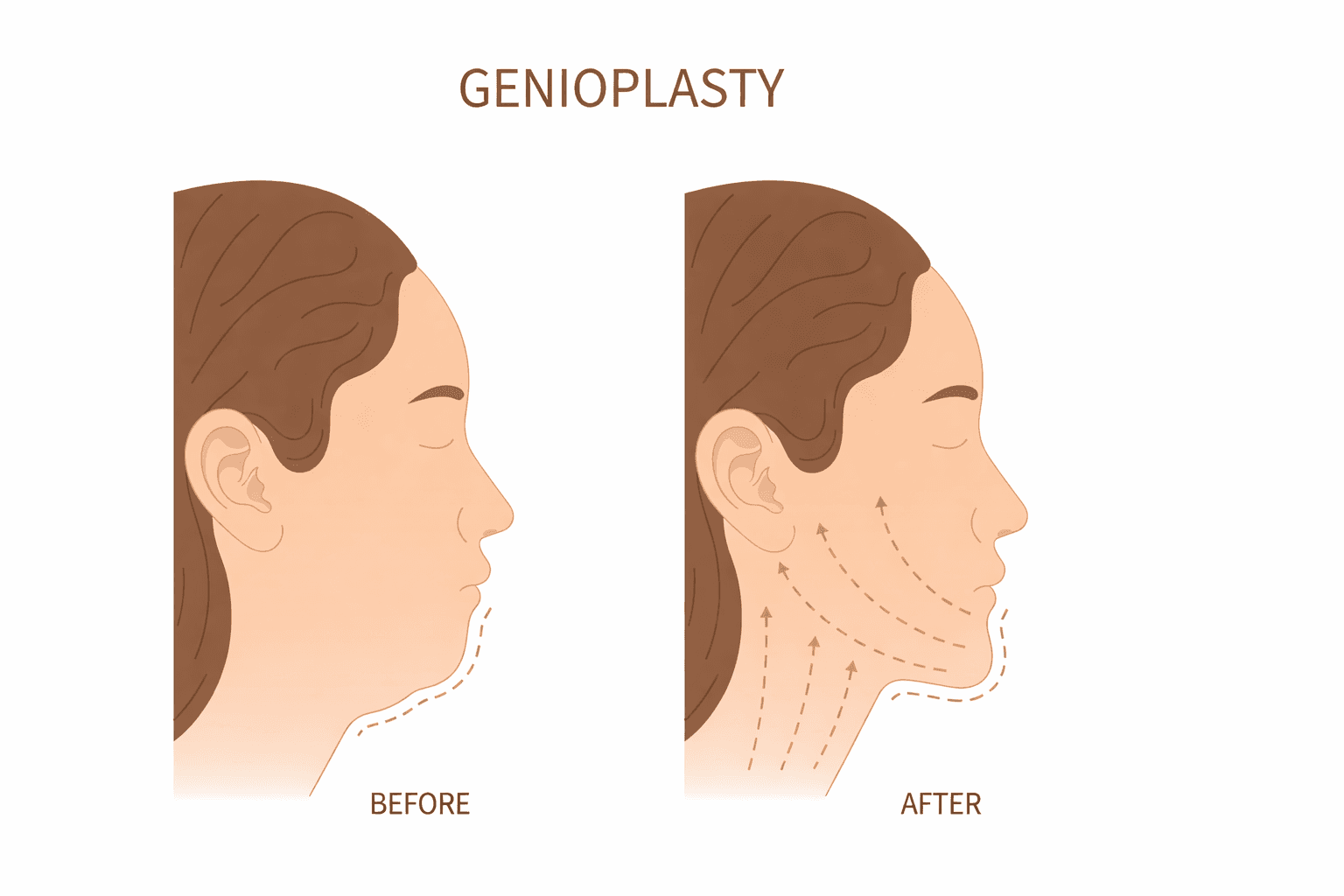
Genioplasty — commonly known as chin surgery — is a facial contouring procedure that reshapes the chin to improve overall facial balance. The chin plays a far more significant role in how the face is perceived than most people realize. Even a few millimeters of adjustment can transform the side profile, refine the jawline, and harmonize the relationship between the nose, lips, and lower face.
Modern genioplasty is not about following a single beauty standard. Skilled Korean surgeons analyze each patient's facial proportions in three dimensions and recommend an approach tailored to their unique anatomy, ethnicity, and goals.
There are three main categories of chin surgery, each addressing a different concern.
1. Weak or Short Chin Correction (Chin Advancement)
A weak or recessed chin can make the face appear unbalanced — particularly in profile view. The lower face often looks softer, the jawline lacks definition, and the overall side silhouette feels unfinished.
Common surgical approaches at our partner clinics in Korea:
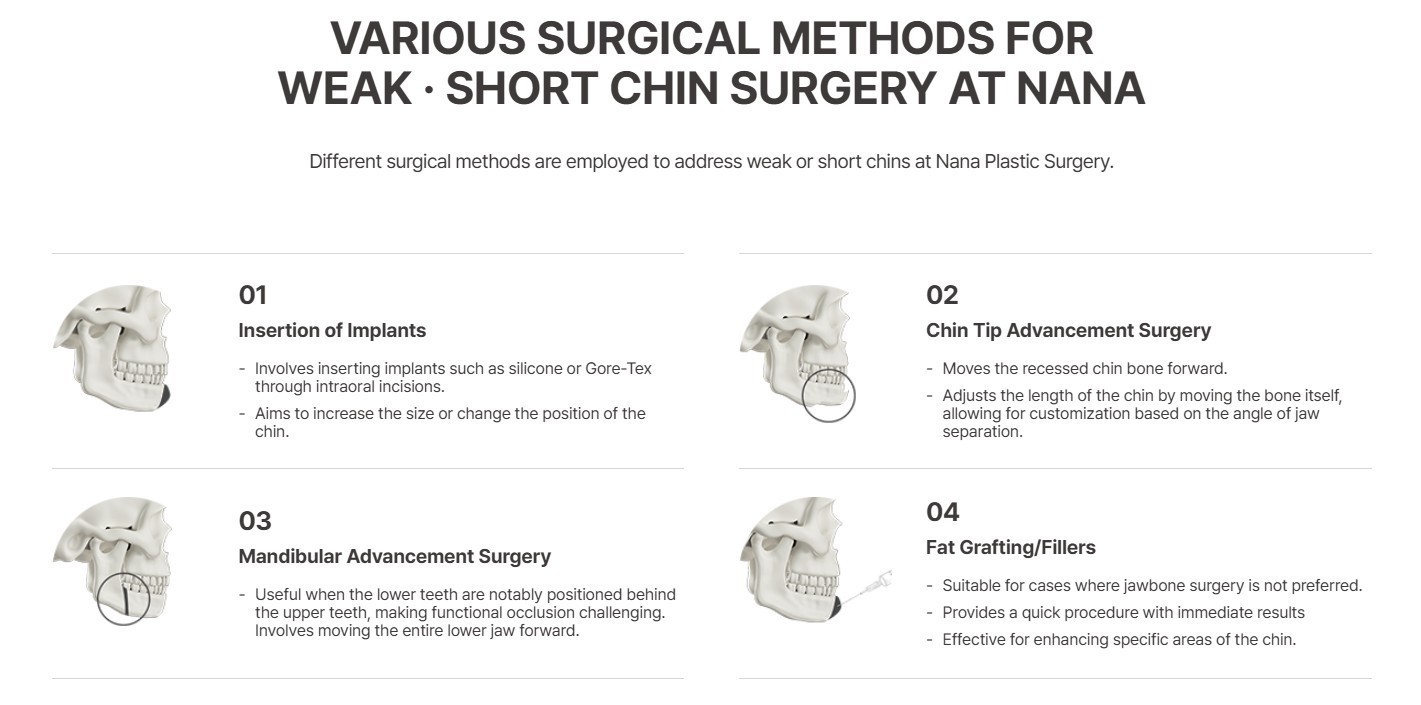
Sliding genioplasty. The chin bone is repositioned forward through a precise osteotomy and secured with titanium plates. This is widely considered the gold standard for structural correction.
Custom implants. For patients seeking moderate enhancement, biocompatible implants — designed to suit a wide range of facial structures — provide reliable, long-term results.
Bone advancement. For more significant correction, controlled bone advancement creates lasting projection while keeping the result natural.
This option is best for:
Patients with a recessed chin in profile
Those seeking improved jawline definition
Anyone wanting a more balanced, masculine or feminine silhouette without an artificial look
2. Chin Tip Augmentation
Chin tip augmentation is a refined option for patients whose chins lack subtle definition rather than significant projection. It's often the right choice for those who want measurable improvement without committing to major bone surgery.
Key advantages:
Less invasive than full sliding genioplasty
Faster recovery — many patients return to work within 1–2 weeks
Ideal for fine-tuning rather than restructuring
Pairs well with rhinoplasty for complete profile harmony
This is one of the most popular procedures among first-time international patients who want noticeable refinement with shorter downtime.
3. Long or Protruding Chin Reduction
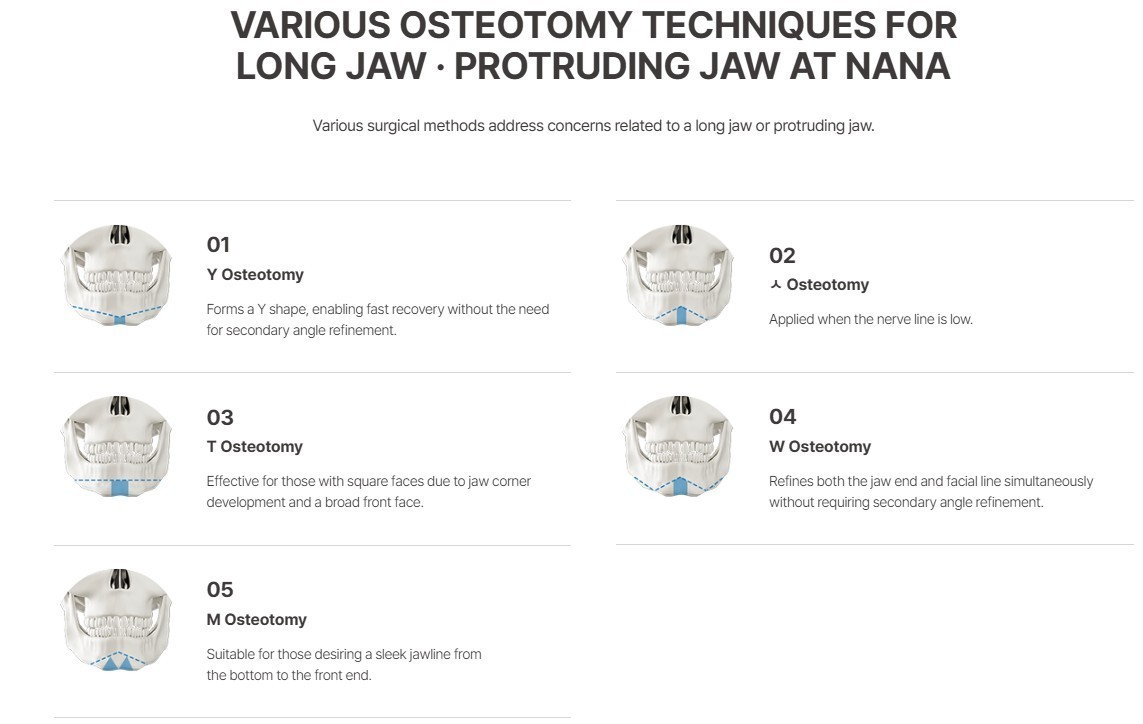
A long, prominent, or forward-projecting chin can make the lower face appear disproportionately strong. Korean surgeons are particularly experienced in reduction genioplasty, which involves:
Bone reduction — carefully removing precise amounts of bone to shorten chin length
Repositioning — adjusting chin position relative to the rest of the face
Smooth contouring — ensuring transitions to the jawline appear seamless
The goal is never to flatten or eliminate the chin. It's to achieve proportional balance that complements your overall face shape.
How to Choose the Right Chin Surgery
The right procedure depends on your specific facial anatomy — not just preference. A skilled surgeon will assess:
Profile angle (especially the nose-lip-chin relationship)
Vertical proportions of your face
Jawline structure
Soft tissue characteristics
Bite and dental alignment

| Concern | Recommended Approach |
|---|---|
| Weak or recessed chin | Sliding genioplasty / chin advancement |
| Flat or undefined chin tip | Chin tip augmentation |
| Long or protruding chin | Reduction genioplasty |
| Asymmetric chin | Customized 3D bone repositioning |
This is why an in-depth consultation — ideally with 3D facial imaging — is essential before deciding on any procedure. We coordinate detailed pre-arrival assessments so you can begin surgical planning before you even land in Seoul.
What to Expect: Your Journey as an International Patient
Traveling abroad for surgery can feel overwhelming. As your medical tourism partner, we handle the logistics so you can focus on your transformation.
Before You Arrive
Online consultation with vetted Korean specialists
Customized procedure planning
Travel and accommodation coordination
Pre-surgical health screening guidance
Cost estimate with no hidden fees
During Your Stay in Seoul
Airport pickup and transfers
In-person consultation and 3D facial analysis
Surgery at a top-tier accredited clinic
Multilingual interpretation throughout
Hospital and recovery accommodation arrangements
After Surgery
Daily check-ins during recovery
Follow-up appointments coordinated
Post-departure care guidance
Long-term remote follow-up support
Recommended length of stay: Most international patients stay in Seoul for 10–14 days for genioplasty alone — enough time for initial recovery, suture removal, and a final check-up before flying home. Combination procedures may require slightly longer.
Why Work with a Medical Tourism Specialist?
Choosing a clinic from another country isn't easy. The internet is full of conflicting reviews, and clinics that market most aggressively to international patients aren't necessarily the ones Korean residents would choose for themselves.
That's where we come in:
Vetted partner network. We work only with board-certified facial contouring specialists at clinics with strong domestic reputations among Korean patients themselves.
Transparent pricing. We help you understand exactly what you're paying for — no hidden fees, no surprise charges.
Independent advocacy. As your representative, we work for you, not for any single clinic.
End-to-end support. From your first inquiry to your post-surgery follow-up, you have a dedicated coordinator.
Cultural and language bridge. We translate medical terminology, cultural nuances, and recovery protocols so nothing gets lost in translation.
For patients in the U.S., Canada, and Singapore who are weighing the decision to travel, the value of working with an experienced agency is straightforward: you get an advocate who knows the Korean medical landscape from the inside.
What Actually Drives the Cost of Genioplasty in Korea
International patients almost always ask for a single number first. It's the wrong first question. Chin surgery isn't one fixed procedure — the price reflects the technique your anatomy requires, who operates, and how much else is happening in the same session. Korea is typically lower than comparable surgery in the U.S., Canada, or Singapore, but the only figure that means anything for your case is a personalized quote built around your scan and goals.
Rather than chase a percentage, it's more useful to understand the cost factors — the things that move a genioplasty quote up or down:
| Cost factor | Why it moves the price | What to ask |
|---|---|---|
| Technique | Sliding genioplasty (bone osteotomy + titanium fixation) and reduction genioplasty are more involved than a chin-tip implant or filler-style refinement. | "Is my correction bone-based or implant-based, and why?" |
| Surgeon seniority | A high-volume facial-bone specialist commands a different fee than a generalist. Experience is where you should not economize. | "How many genioplasties does the operating surgeon perform per year?" |
| Combination procedures | Adding rhinoplasty or jaw contouring raises the total but is often more efficient than two separate trips. | "What's the all-in if I combine versus stage these?" |
| Anesthesia & facility | General anesthesia, anesthesiologist coverage, and accredited-facility fees are real line items. | "Is a board-certified anesthesiologist present for the whole case?" |
| Hospital / recovery stay | Overnight observation, swelling-management visits, and suture removal add to the all-in, separate from the surgical fee. | "What aftercare visits are included in the quoted price?" |
Treat any quote that omits anesthesia, facility, and aftercare as incomplete. A transparent all-in estimate — surgical fee, anesthesia, facility, follow-ups, and any combination work — is the only fair way to compare Korea against a quote back home. We build that estimate around your specific case before you commit to travel.
Scope note: This guide covers the genioplasty procedure itself — technique, cost factors, and recovery milestones. How many days you should stay in Seoul and when it's safe to fly home are covered in our dedicated recovery-stay guide, because the right answer depends on your full procedure plan, not the chin alone.
Recovery, Week by Week
Recovery from chin surgery is gradual and, for most patients, more about swelling and tightness than pain. The timeline below anchors the general milestones — but everyone heals at their own pace, and bone-based procedures (sliding and reduction genioplasty) take longer to fully settle than tip refinements. Always defer to your operating surgeon's specific clearance.
| Phase | What to expect |
|---|---|
| Week 1 | Peak swelling and bruising around the chin and lower lip. A chin tape or support dressing is common. Soft diet, head elevation, no strenuous activity. Speaking and chewing feel awkward. |
| Weeks 2–3 | The most visible swelling subsides; sutures are typically removed and many patients feel presentable enough to travel. Numbness of the chin/lower lip is normal and resolves slowly. |
| Weeks 4–6 | You look largely "back to normal" to others. Residual deep swelling lingers and contour continues to refine. Light exercise usually resumes per your surgeon's guidance. |
| 3–6 months | Final refinement. Bone healing and tissue settling complete; the true result becomes visible. Any lingering numbness usually continues to recover over this window. |
A note on bite (occlusion) changes
This is the part many international patients aren't warned about. With sliding or reduction genioplasty, the chin segment is repositioned — and as swelling resolves and tissues settle, your bite can feel different at first. For most isolated chin procedures this sensation is temporary and the actual tooth contact is unchanged. But if your case involves significant repositioning, or if your chin concern is tied to underlying jaw alignment, orthodontic coordination may matter — and your surgeon should flag that before you operate, not after. Ask directly: "Will this change how my teeth meet, and do I need an orthodontic or jaw-alignment opinion first?" If your goals are really about a longer or wider lower face, this conversation naturally overlaps with jaw contouring and lower-face balance — the same territory discussed in our volume and mini facelift guide for soft-tissue contour and our full facelift guide for structural lower-face rejuvenation.
Genioplasty vs Chin Filler vs Chin/Jaw Implant
These three are constantly confused, yet they sit in different categories entirely. None is "best" in the abstract — they solve different problems with different trade-offs.
| Option | Permanence | What it changes | Trade-offs |
|---|---|---|---|
| Genioplasty (bone) | Permanent — it modifies your own bone structure | Repositions the actual chin bone (forward, shorter, or realigned) | Most powerful for structural change; surgical recovery; reversible only with further surgery |
| Chin filler | Temporary — typically lasts months, then reabsorbs | Adds soft-tissue volume/projection without touching bone | No surgery, minimal downtime; subtle and impermanent; not for true structural deficits |
| Chin / jaw implant | Long-lasting; can be removed or revised | Adds projection or contour over the existing bone via a biocompatible implant | A defined surgical procedure; long-lasting; implant maintenance/revision is possible over time |
In short: filler tests an idea, an implant augments over your bone, and genioplasty reshapes the bone itself. A genuine consultation should explain why your anatomy points to one over the others — not simply offer whichever the clinic prefers.
Verifying Who Actually Operates: SMI's No Ghost Doctor Stance
For bone-based facial surgery, who holds the instruments matters as much as which clinic you booked. "Ghost surgery" — where a different, sometimes unqualified person operates after you've consulted a senior surgeon — is the single concern we take most seriously for international patients who can't easily verify things on the ground.
Our No Ghost Doctor stance is built on verifiable facts, not reassurance:
- Named operating surgeon, in writing. You should know the specific surgeon performing your genioplasty before you travel — by name, not "our team."
- Specialist registration. Korean facial surgeons can be checked against professional bodies such as the Korean Society of Plastic and Reconstructive Surgeons (KSPRS). A real specialist has a verifiable credential.
- Operating-room transparency. Korea enacted a law (passed in 2021, effective from September 2023) requiring operating rooms to allow CCTV recording where patients are under general anesthesia, carried out at the patient's request — a concrete, verifiable safeguard you can ask any clinic about.
- Consent that names the surgeon. Your surgical consent and records should identify the operating surgeon. Vague paperwork is a red flag.
As a government-registered facilitator, our role is to make these checks happen on your behalf and to keep the clinic accountable to what was promised at consultation. Safety verification is something you should expect to be walked through — not something you have to chase down yourself. For a full walkthrough of confirming your operating surgeon and avoiding ghost surgery, see our guide to safe plastic surgery in Korea.
Seoul Medical Insider works with accredited, government-registered partner clinics in Seoul — including NANA, Wonjin, Banobagi, and DA Plastic Surgery — and matches you to the right specialist for your case.
Medical disclaimer & facilitator note: Seoul Medical Insider is a government-registered medical tourism facilitator, not a medical provider, clinic, or medical practice. This article is for educational purposes only and does not constitute medical advice, diagnosis, or treatment, nor does it replace a consultation with a board-certified surgeon. Surgical suitability, technique, risks, recovery, and outcomes vary by individual and can only be determined by a qualified, licensed surgeon who has examined you. Always discuss your personal complication and revision rates, anesthesia plan, and any bite or orthodontic considerations directly with your operating surgeon before proceeding.
Clinical details are summarized from materials provided by SMI's partner clinics and published guidance from the Korean Society of Plastic and Reconstructive Surgeons (KSPRS). Technique selection is determined by your surgeon during consultation. SMI is a registered patient-facilitation agency, not a medical provider, and does not offer medical advice.
Related procedure guide See the full Genioplasty (Chin Surgery) guideFrequently asked questions
Sources
- Ministry of Health and Welfare, Republic of Korea
- Medical Korea (KHIDI)
- Korea Health Industry Development Institute (KHIDI)
- Korean Society of Plastic and Reconstructive Surgeons (KSPRS)
Read our editorial policy to learn how we source and verify information.
