
Procedure guide
Sub-Brow Lift in Korea
- Surgery time Around 0.5 – 1 hour
- Anesthesia type Local anesthesia with sleeping sedation
- Hospitalization Not required
- Face wash & makeup 7 days after surgery
- Post-surgery check-up 1 time (depending on the patient's condition)
- Stitches removal 7 days after surgery



The sub-brow lift is an upper eyelid rejuvenation procedure that removes a crescent of excess skin and soft tissue directly below the eyebrow. Unlike traditional double eyelid surgery, which places the incision on the eyelid itself, the sub-brow approach lifts drooping upper lid skin from above — restoring the original eyelid crease and youthful lid platform without creating a new fold or changing the eye's fundamental shape.
This technique is especially popular among Korean surgeons for patients who already have a double eyelid fold that has become hidden by sagging skin with age, or for patients who want a refreshed upper eyelid without the look of "having had double eyelid surgery." The scar sits just beneath the brow hair and becomes nearly invisible once healed.
At a glance | |
Surgery time | 30 – 50 minutes |
|---|---|
Anaesthesia | Local with sedation |
Hospital stay | Outpatient — discharged same day |
Back to routine | 5 – 7 days |
Final result | 2 – 3 months |
This page is for informational purposes. Individual results vary. A board-certified surgeon should evaluate your anatomy before any procedure.
How it works
The sub-brow lift addresses upper lid heaviness at its source — the tissue between the brow and the lid crease — rather than altering the eyelid fold itself.
- Planning & marking — The surgeon pinches the excess skin below the eyebrow to determine how much can be safely removed while maintaining comfortable eye closure. The lower incision line follows the natural inferior border of the brow; the upper line tracks along the lower edge of the brow hair to hide the scar.
- Anaesthesia — Local anaesthetic is infiltrated along the marked area. Light IV sedation ensures comfort.
- Excision — A crescent-shaped strip of skin and underlying orbicularis oculi muscle is excised. The width of the excision (typically 8 – 15 mm at the widest point) is tailored to the degree of hooding. Removing a small amount of muscle reduces bulk and prevents the remaining skin from re-draping quickly.
- Lifting & repositioning — The lower skin edge is drawn upward and sutured to the deeper brow tissue, lifting the upper eyelid skin and re-exposing the original lid crease and platform.
- Closing — The incision is closed in layers with fine absorbable deep sutures and external skin sutures or adhesive strips. The scar line sits directly beneath the brow hairs. Sutures are removed around day 5 – 7.
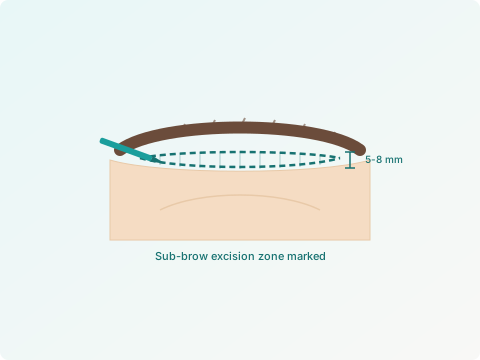
Skin excess measurement
The surgeon pinches the skin below the eyebrow to determine exactly how much excess tissue causes the hooding, and marks the excision area.
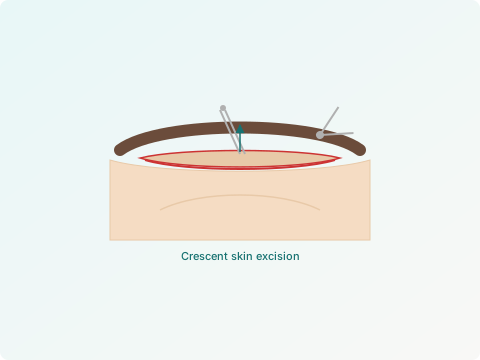
Sub-brow incision
An incision is made directly below the lower border of the eyebrow, following the natural brow curvature for optimal scar concealment.
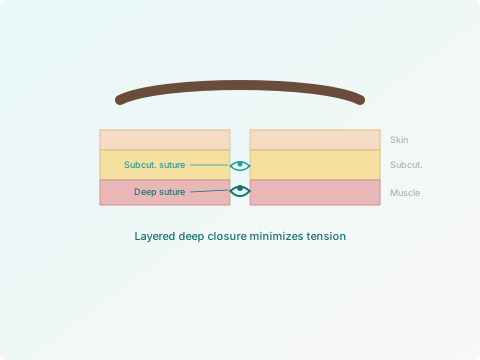
Tissue excision & lifting
The measured strip of excess skin and underlying orbicularis muscle is excised, lifting the upper eyelid tissue and revealing more of the eyelid platform.
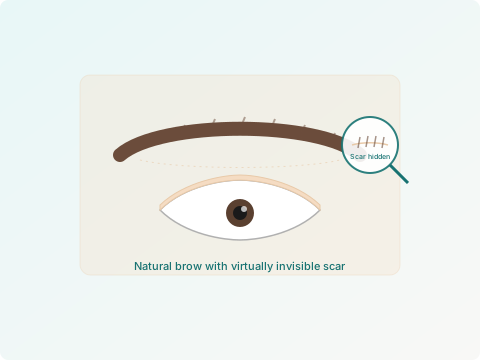
Closure within brow line
The incision is meticulously closed with fine sutures that sit within the brow hair line. The scar becomes virtually invisible once healed.
Cost · as of 2026
Through Seoul Medical Insider, the sub-brow lift in Korea is priced transparently with the surgeon's fee, anaesthesia, facility, and standard follow-up visits included. There is no agency markup.
The cost depends on the extent of tissue removal, whether fat debulking is performed in the sub-brow area, and whether the procedure is performed alone or combined with other eyelid surgeries such as double eyelid revision or ptosis correction. A standalone sub-brow lift is generally one of the more affordable upper-eyelid procedures.
All pricing is reviewed and confirmed as of 2026. Request a quote through our consultation form with photos showing your brows and upper lids from the front and at a slight downward gaze.
Who it is for
The sub-brow lift is an excellent option for a specific patient profile — those with upper lid heaviness originating from tissue laxity between the brow and the crease.
- Suited for: Patients aged 35 and older whose upper eyelid skin has begun to sag, covering an existing double eyelid fold and making the lid platform disappear.
- Suited for: Patients who want eyelid rejuvenation but do not want the appearance of a new double eyelid crease — the sub-brow lift preserves the natural fold.
- Suited for: Patients with thick, heavy sub-brow skin that contributes to a puffy or hooded upper lid appearance.
- Discuss carefully: Younger patients with minimal skin excess — they may benefit more from a non-incision double eyelid procedure or upper blepharoplasty.
- Discuss carefully: Patients whose brow itself has dropped significantly — a forehead or brow lift may be more appropriate than a sub-brow excision alone, or the procedures may need to be combined.
Recovery
- Week 1: Mild to moderate swelling and possible bruising around the brow and upper lid. The brow area may feel tight. Sutures are removed around day 5 – 7. Cold compresses and head elevation help manage swelling. Avoid heavy lifting and bending.
- Weeks 2 – 3: Swelling resolves significantly. The scar beneath the brow is pink but easily concealed by brow pencil or powder makeup once cleared by the surgeon (usually after suture removal). Normal daily activities resume.
- Weeks 4 – 8: The scar fades progressively. The lifted upper lid platform is clearly visible and the crease looks refreshed. Residual firmness softens.
- Months 2 – 3: The final result is apparent. The scar line beneath the brow hair is typically very difficult to detect. The eyes look naturally more open and youthful.
Stay in Korea for at least 7 days to attend suture removal and a healing check. Because the sub-brow lift has a relatively gentle recovery, most patients feel socially comfortable within 10 days.
Risks & considerations
The sub-brow lift is a straightforward procedure with a favourable safety profile, but potential risks include visible scarring beneath the brow if the incision does not heal well (mitigated by placing the cut within the brow hairline and using meticulous closure technique), temporary numbness or altered sensation in the forehead skin above the brow due to sensory nerve disruption, asymmetry in the amount of skin removed between the two sides, under-correction requiring a secondary excision, over-correction making the brow appear unnaturally elevated, and, very rarely, haematoma or wound infection. Scar management with silicone gel or tape may be recommended for the first few months post-op.
Korea trip checklist
- Provide front-facing photos showing your natural brow position and upper lids (without brow makeup) during the online consultation — the surgeon needs to evaluate true brow-to-lid distance.
- Discontinue blood thinners (aspirin, ibuprofen, omega-3, vitamin E) at least 7 days before surgery.
- If you regularly get brow microblading or tattooing, inform your surgeon — the incision sits just below the brow hair and the procedure should not damage existing brow tattoo work, but the surgeon needs to plan the incision line accordingly.
- Bring a tinted brow pencil or powder for after suture removal — light makeup can camouflage the healing scar line from about day 7 onwards.
- Arrange accommodation near the clinic for the first week. Suture removal and a scar assessment are done around day 5 – 7.
- Book your return flight for day 7 or later. The sub-brow lift recovery is relatively mild, but the surgeon should verify healing before you travel.
Clinical details are summarized from materials provided by SMI's partner clinics and published guidance from the Korean Society of Plastic and Reconstructive Surgeons (KSPRS). Technique selection is determined by your surgeon during consultation. SMI is a registered patient-facilitation agency, not a medical provider, and does not offer medical advice.
Why get this procedure in Korea
-
World-leading surgical volume
Korean plastic surgeons perform more facial procedures per capita than any other country, refining techniques through high case volumes.
-
Board-certified specialists
All SMI partner surgeons hold Korean Board of Plastic Surgery certification and operate at JCI or KOIHA-accredited facilities.
-
40-60% cost savings
Comparable or superior results at a fraction of US/EU pricing, with no compromise on safety standards or technology.
You may also consider
Related guides
- Double Eyelid Surgery in Korea: A Complete Cost & Methods Guide A clear, educational guide to double eyelid surgery in Korea — incisional vs non-incisional, what drives cost, recovery, and choosing a surgeon.
- Ponytail Lift in Korea: A Guide to Endoscopic Brow and Midface Lifting for International Patients The ponytail lift is a minimally invasive endoscopic approach to brow and midface rejuvenation. Here is what international patients should know about candidacy, costs, longevity, and planning a trip to Korea.
- How Long Should You Stay in Korea After Plastic Surgery? A logistics hub for international patients — typical recovery-stay windows by procedure, when you can safely fly home, and the visa and interpreter basics for a trip to Seoul.
Frequently asked questions
Sources
- Ministry of Health and Welfare, Republic of Korea
- Medical Korea (KHIDI)
- Korea Health Industry Development Institute (KHIDI)
- Korean Society of Plastic and Reconstructive Surgeons (KSPRS)
- International Society of Aesthetic Plastic Surgery (ISAPS)
Read our editorial policy to learn how we source and verify information.
