Procedure guide
Two Jaw Surgery (Bimaxillary Osteotomy) in Korea
- Surgery time Around 2 – 4 hours
- Anesthesia type General anesthesia
- Hospitalization 2 – 3 nights
- Face wash & makeup 3 days after surgery
- Post-surgery check-up 3 – 4 times (depending on the patient's condition)
- Stitches removal 14 days after surgery



Two jaw surgery — formally known as bimaxillary osteotomy — simultaneously repositions both the upper jaw (maxilla via Le Fort I osteotomy) and the lower jaw (mandible via bilateral sagittal split osteotomy). It is the most comprehensive form of orthognathic surgery and is indicated when significant skeletal discrepancies exist in both jaws, causing functional problems such as malocclusion, breathing difficulties, or TMJ dysfunction, as well as aesthetic concerns like facial asymmetry, a long face, or a severely receding profile.
South Korea performs more two-jaw surgeries per capita than virtually any other country, driven by both medical need and aesthetic demand. This extraordinary case volume has produced surgeons with deep expertise, supported by virtual surgical planning (VSP), patient-specific cutting guides, and state-of-the-art post-operative monitoring facilities. International patients benefit from a mature, well-organised treatment pathway.
| Surgery time | 3 – 5 hours |
|---|---|
| Anaesthesia | General anaesthesia |
| Hospital stay | 2 – 3 nights |
| Back to routine | 3 – 6 weeks |
| Final result | 6 – 12 months |
The information on this page is for educational purposes and does not replace a professional medical consultation. Individual anatomy, health status, and surgical goals vary — always consult a qualified surgeon before making decisions.
How it works
Two jaw surgery combines a Le Fort I osteotomy of the maxilla with a bilateral sagittal split osteotomy (BSSO) of the mandible in a single operative session. By moving both jaws, the surgeon can correct complex three-dimensional deformities that a single-jaw approach cannot address alone.
- Planning — Extensive imaging (3-D CT, cephalometric X-rays) and dental records are imported into virtual surgical planning software. The surgeon simulates millimetre-precise movements of both jaws, checking occlusion, airway dimensions, and facial aesthetics. Custom cutting guides and an intermediate and final surgical splint are 3-D printed. Pre-surgical orthodontics (typically 6 – 18 months) aligns the teeth so they mesh correctly in the planned post-surgical position.
- Anaesthesia — General anaesthesia is administered via nasotracheal intubation. Continuous monitoring of blood pressure, temperature, and — in many Korean centres — facial-nerve function is standard.
- Access — The upper jaw is accessed through an incision inside the mouth along the upper gum line (vestibular incision). The lower jaw is accessed through bilateral incisions inside the mouth behind the lower molars.
- Reshaping — Upper jaw (Le Fort I): The maxilla is cut horizontally and freed from the nasal septum and pterygoid plates. It is repositioned according to the plan — advanced, impacted, rotated, or tilted — and fixed with titanium mini-plates. The intermediate splint is used to set the upper jaw against the (still-unmoved) lower teeth. Lower jaw (BSSO): The mandible is split sagittally on both sides. The tooth-bearing segment is repositioned to fit the final splint, achieving the planned occlusion, and is secured with titanium plates or bicortical screws. A genioplasty (chin adjustment) is often added at this stage if needed.
- Closing — All incisions are closed with absorbable sutures. The final splint is secured with elastics or wire. A light compression dressing is applied. The patient is transferred to a monitored recovery unit.
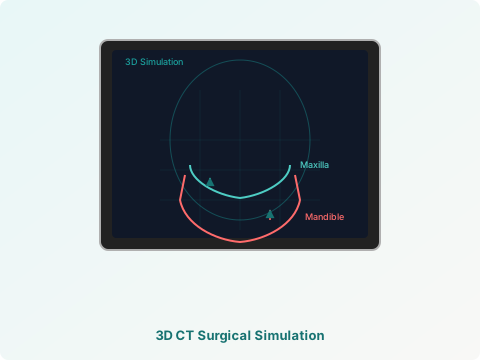
Comprehensive planning
Extensive imaging including 3D CT, cephalometric analysis, and virtual surgical simulation determine the precise movements for both the maxilla and mandible.
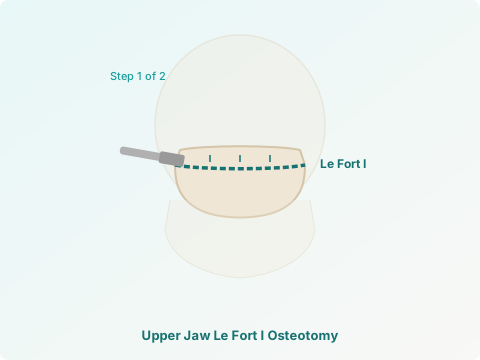
Upper jaw (Le Fort I) osteotomy
The maxilla is cut and repositioned first — moved up, down, forward, or rotated — to establish the ideal upper dental arch position and facial midline.
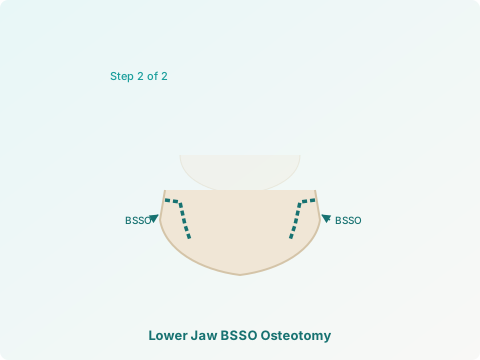
Lower jaw (BSSO) osteotomy
The mandible is then cut and repositioned relative to the newly placed maxilla, correcting the bite, chin position, and overall facial symmetry.
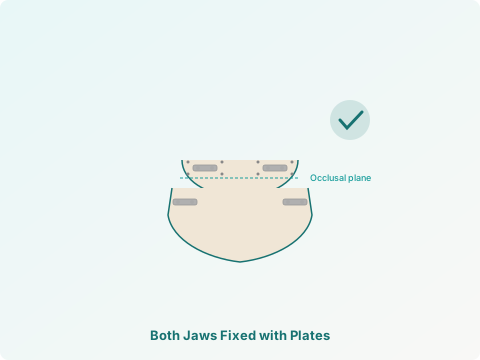
Fixation & ICU monitoring
Both jaws are secured with titanium plates. Patients stay in the hospital for 2-3 days with airway monitoring. A strict liquid diet follows for 4-6 weeks.
Cost · as of 2026
Seoul Medical Insider is committed to transparent pricing. We present the clinic's actual fee with a clear line-item breakdown — surgeon, anaesthesia, hospital stay, splint fabrication, and standard follow-up — so there are no surprises.
Two jaw surgery in Korea typically ranges from KRW 10,000,000 to KRW 20,000,000 (approximately USD 7,500 – 15,000). The wide range reflects differences in case complexity (simple advancement versus multi-vector correction with genioplasty), whether custom 3-D printed cutting guides are used, the hospital tier, and the surgeon's credentials. Adding a genioplasty or additional facial-contouring work increases the total but is often bundled at a reduced incremental rate. Pre-surgical orthodontics, if done in Korea, is priced separately.
All pricing information is reviewed and updated as of 2026. Contact Seoul Medical Insider with your imaging for an individualised cost estimate.
Who it is for
Two jaw surgery is the most involved elective facial procedure and is reserved for cases where both jaws contribute to the skeletal imbalance.
- Suited: Patients with Class II or Class III skeletal malocclusion involving both maxilla and mandible — for example, a protruding upper jaw combined with a receding lower jaw.
- Suited: Individuals with significant facial asymmetry where the midline of the upper and lower jaws do not align and cannot be corrected by moving one jaw alone.
- Suited: Patients with vertical maxillary excess (gummy smile) combined with mandibular deficiency, or open-bite deformities of skeletal origin.
- Suited: Adults with obstructive sleep apnoea linked to retropositioned jaws, where maxillomandibular advancement (MMA) can expand the airway.
- Discuss carefully: Patients who have not completed facial growth — surgery should generally wait until growth is complete (typically 18+ for females, 20+ for males) to prevent relapse.
- Discuss carefully: Those with untreated TMJ disorders — the joint condition should be stabilised before or addressed during surgery.
- Discuss carefully: Patients with bleeding disorders or conditions affecting bone healing (uncontrolled diabetes, heavy smoking, long-term steroid use).
Recovery
- Week 1 — Extensive facial swelling reaching its peak around days 2 – 3, then slowly receding. The jaws are guided by elastics (rigid inter-maxillary fixation is rarely used in modern Korean practice). Diet is entirely liquid, delivered by syringe or cup. Breathing through the nose may be difficult; a humidifier and saline spray help. Numbness of the lower lip, chin, and upper lip is universal at this stage. Hospital stay is typically 2 – 3 nights with IV antibiotics and fluids.
- Weeks 2 – 3 — Swelling reduces markedly. Elastic configurations are adjusted to encourage gentle jaw movement. Patients progress from liquids to blended and puréed foods. Oral hygiene is critical — gentle brushing with a paediatric toothbrush and chlorhexidine rinse is standard. Light indoor activity is fine; avoid bending or lifting.
- Weeks 4 – 8 — Soft-food diet (scrambled eggs, steamed fish, soft rice) is introduced around week 4 – 6. Elastics are gradually reduced. Post-surgical orthodontic adjustments may start around week 6. Light exercise such as walking and cycling can resume; contact sports remain off-limits.
- Months 3 – 12 — Bone consolidation is largely complete by month 3 – 4. Diet returns to near-normal by month 3, though very hard or chewy foods should be avoided until month 6. Nerve sensation gradually returns; most patients recover substantially within 6 – 12 months, though minor numbness in some areas can persist. The final facial profile, soft-tissue drape, and bite stabilise over the full year.
For two jaw surgery, international patients should plan a stay of at least 14 – 21 days in Seoul. This allows for hospital discharge, multiple follow-up visits, imaging to confirm bone position, elastic adjustments, and clearance by the surgeon before long-haul travel.
Risks & considerations
Two jaw surgery is a major operation and, while routinely performed in Korea, it carries meaningful risks that patients must understand. These include temporary numbness of the lower lip, chin, and cheeks — which is nearly universal — with a small percentage of patients experiencing prolonged or permanent sensory changes due to inferior alveolar or infraorbital nerve injury; unfavourable bone splits during BSSO; post-operative malocclusion or bite relapse requiring revision or extended orthodontic treatment; haemorrhage, particularly from the descending palatine or maxillary arteries during the Le Fort I cut; infection at osteotomy sites or around titanium hardware; TMJ dysfunction, condylar resorption, or new-onset jaw-joint pain; velopharyngeal insufficiency (nasal-sounding speech) if the palate is significantly repositioned; nasal septum deviation or airway changes after maxillary movement; wound dehiscence along the intraoral incisions; and, in rare cases, avascular necrosis of a jaw segment. The risk of life-threatening complications is very low but non-zero for any procedure under prolonged general anaesthesia. Selecting a high-volume orthognathic surgery centre with ICU-level post-operative monitoring is the single most important risk-reduction measure.
Korea trip checklist
- Complete pre-surgical orthodontics before travelling — this is typically the longest preparatory step (6 – 18 months). Coordinate closely between your home orthodontist and the Korean surgical team.
- Send a full record set to the clinic in advance: 3-D CT, cephalometric X-ray, panoramic X-ray, intraoral scan or dental models, and orthodontic progress notes.
- Stop smoking at least 6 weeks before surgery — tobacco use is a significant risk factor for impaired bone healing and infection.
- Discontinue blood-thinning medications and supplements (aspirin, NSAIDs, fish oil, vitamin E, ginkgo) at least two weeks prior, as directed by your surgeon.
- Prepare extensively for a liquid diet: pack a compact blender, syringes, protein powders, electrolyte sachets, and vitamin supplements. Korean convenience stores also carry meal-replacement drinks.
- Book accommodation near the hospital for 14 – 21 days. You will attend multiple follow-up appointments for imaging, elastic changes, and wound checks.
- Arrange for a companion during the first week — assistance with meals, medication schedules, and communication (especially if you experience jaw stiffness or speech difficulty) is highly valuable.
- Confirm comprehensive travel/health insurance that covers major surgical complications abroad, including potential emergency re-admission.
Clinical details are summarized from materials provided by SMI's partner clinics and published guidance from the Korean Society of Plastic and Reconstructive Surgeons (KSPRS). Technique selection is determined by your surgeon during consultation. SMI is a registered patient-facilitation agency, not a medical provider, and does not offer medical advice.
Why get this procedure in Korea
-
World-leading surgical volume
Korean plastic surgeons perform more facial procedures per capita than any other country, refining techniques through high case volumes.
-
Board-certified specialists
All SMI partner surgeons hold Korean Board of Plastic Surgery certification and operate at JCI or KOIHA-accredited facilities.
-
40-60% cost savings
Comparable or superior results at a fraction of US/EU pricing, with no compromise on safety standards or technology.
You may also consider
Related guides
- Two-Jaw Surgery in Korea: What International Patients Need to Know Two-jaw surgery corrects functional and aesthetic jaw misalignment by repositioning both the upper and lower jaw. Korea has become a leading destination for this complex procedure — here's what international patients should know before committing.
- Facial Feminization Surgery (FFS) in Korea: Procedures, Costs, and How to Choose a Qualified Clinic Facial feminization surgery in Korea combines forehead contouring, jaw and chin reduction, rhinoplasty, and other procedures into a coordinated plan. Here is what international patients should know about costs, recovery, and verifying a board-certified surgeon.
- Is Plastic Surgery in Korea Safe? A Patient's Guide to Avoiding Ghost Surgery A balanced look at safety in Korea's plastic surgery industry — what ghost surgery is, the laws that protect you, and the checks every international patient should make before booking.
- The Real All-In Cost of Plastic Surgery in Korea (Beyond the Quote) The surgery quote is only part of the bill. A clear, honest framework for the all-in cost of plastic surgery in Korea — every line item, plus how to avoid hidden fees and the foreigner price gap.
Frequently asked questions
Sources
- Ministry of Health and Welfare, Republic of Korea
- Medical Korea (KHIDI)
- Korea Health Industry Development Institute (KHIDI)
- Korean Society of Plastic and Reconstructive Surgeons (KSPRS)
- International Society of Aesthetic Plastic Surgery (ISAPS)
Read our editorial policy to learn how we source and verify information.
